

Psychologists refer to a feeling of satisfaction after a good deed as experiencing a warm glow. With each action you take to reduce your emissions, especially with the daily tasks that might include sipping coffee with almond milk instead of cream, getting in an EV or hybrid to drive to work, or ordering a vegetarian meal for lunch, I encourage you to take a moment to consciously feel that inner satisfaction.

Linking these positive emotions to your actions that cut greenhouse gas emissions is critical to support your habitual repetition of these actions.
“Climate change is a highly emotional issue. For example, many people experience negative emotions like climate anxiety and eco-depression. Recent work emphasizes that positive emotions also influence how individuals engage with sustainability and pro-environmental behavior. Behaving in an environmentally friendly way may elicit positive feelings (warm glow), which could drive a self-reinforcing positive feedback loop.” (Zhou et al 2026)
Experiencing a positive emotional reward when you act in a way that cuts your emissions is critical for supporting the repetition of those actions. Our habits are structured around these rewards we feel while or immediately after our actions. James Clear in his 2018 NYT best seller Atomic Habits builds his book on a description of the four pieces that create a habit:
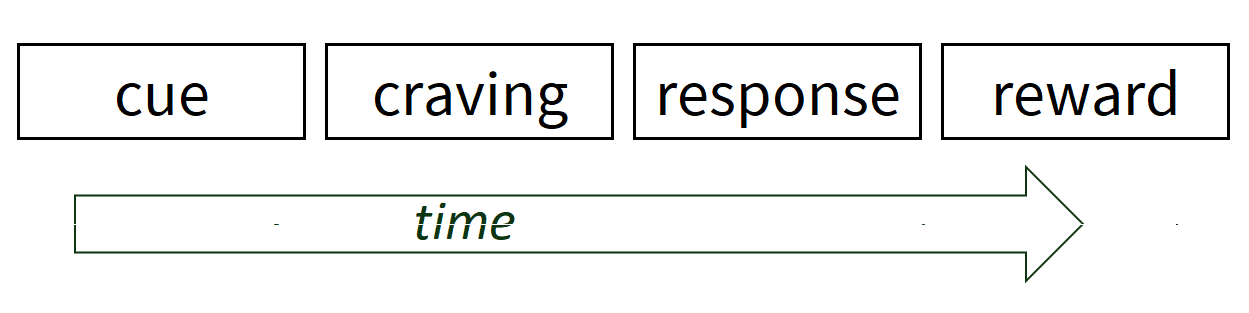
When we talked about changing our diet, I focused on changing or controlling the cue in this sequence. Today, I will focus on the reward we feel. When the reward is immediately linked to the action, the positive reward reinforces the likelihood that we will repeat a behavior. With no reward, any action is unlikely to be repeated or turned into a habit. This concept is so critical that James Clear formalizes the reward as his Fourth Law, “Make It Satisfying”.
Here are some examples of how to implement this simple act of personal appreciation as a part of our everyday behavior:
When you eat a vegetarian meal at a restaurant, take a minute and feel that warm glow knowing that this habit reduces your emissions, helps support restaurants that offer vegetarian options, and communicates to the people you eat with that lowering emissions is important (even if no words are said). Feel that warm glow.
When you plan your next vacation destination for a regional destination you will drive to, take a minute and reflect that not only are you going to enjoy the regional destination with all it has to offer, but you are significantly reducing emissions by not getting on a plane for your trip – an action that lives out your values. Feel that warm glow.
When you charge your electric vehicle, or even fill up your high-mileage hybrid, take a moment to reflect that by driving your lower-emission vehicle you are making a dent in our largest category of emissions, transportation. Feel that warm glow.
When you sign that contract for a green home improvement like buying a new heat pump furnace or heat pump water heater, installing needed insulation, or adding solar panels to your home, stop and take a moment to feel good knowing that your actions, while costing you capital you could have spent in other ways, will cut emissions for years to come. A personal green investment that lowers emissions every year even if you move out of the home. Yup, feel that warm glow.
James Clear describes the issue this way (Atomic Habits chapter 15):
“The brain’s tendency to prioritize the present moment means you can’t rely on good intentions. When you make a plan–to lose weight, write a book, or learn a language–you are actually making plans for your future self.”
This is particularly true for plans to reduce greenhouse gas emissions–where you are making plans related to our collective futures. James Clear continues…
“And when you envision what you want your life to be like, it is easy to see the value in taking actions with long-term benefits. We all want better lives for our future selves. However, when the moment of decision arrives, instant gratification usually wins. You are no longer making a choice for Future You, who dreams of being fitter or wealthier or happier. You are choosing for Present You, who wants to be full, pampered, and entertained. As a general rule, the more immediate pleasure you get from an action, the more strongly you should question whether it aligns with your long-term goals…
“What is immediately rewarded is repeated. What is immediately punished is avoided.”
…
“What we’re really talking about here–when we’re discussing immediate rewards–is the ending of a behavior. The ending of any experience is vital because we tend to remember it more than other phases. You want the ending of your habit to be satisfying. The best approach is to use reinforcement, which refers to the process of using an immediate reward to increase the rate of a behavior.”
And what better reinforcement for our actions to reduce our greenhouse gas emissions than a moment where we look back on the action and internalize that we are living according to our values. In that moment, experience a warm glow.
You can also help others experience that warm glow.
When you see another person taking a positive step to cut emissions, no matter how large or small, you can reach out to them and compliment them. Help them attach that warm glow from your recognition to their actions. When people’s actions are seen and noticed, it increases the cohesive social norm that these green choices are a positive step in our lives. Don’t make this a social media post about their actions, really reach out with a phone call, lunch, or simple word of encouragement when you see them. Help your network experience the same warm glow in response to their green actions.
Jim
RECOMMENDED READ: Pick up a copy of James Clear’s Atomic Habits, and read the book as a manual on how to adopt behaviors to cut your greenhouse gas emissions. Put James Clear’s solid suggestions and strategies to work changing your behaviors in ways that cut your emissions.