

If you own a car, driving an electric vehicle (EV) is a meaningful step to reduce greenhouse gas emissions. EVs are affordable, practical, and cleaner than traditional internal combustion engines (ICE) vehicles.
Electric Vehicles are affordable.
In December of 2025, car shoppers paid an average of $50,326 for new cars according to Kelley Blue Book. Of the top ten EVs sold last year in the United States, eight have base models in 2026 priced below the average cost of a new internal combustion engine vehicle. This is a significant shift from previous years. For many models, prices dropped after the EV tax credits were removed and manufacturers adjusted prices to assure their vehicles were competitive in the United States.
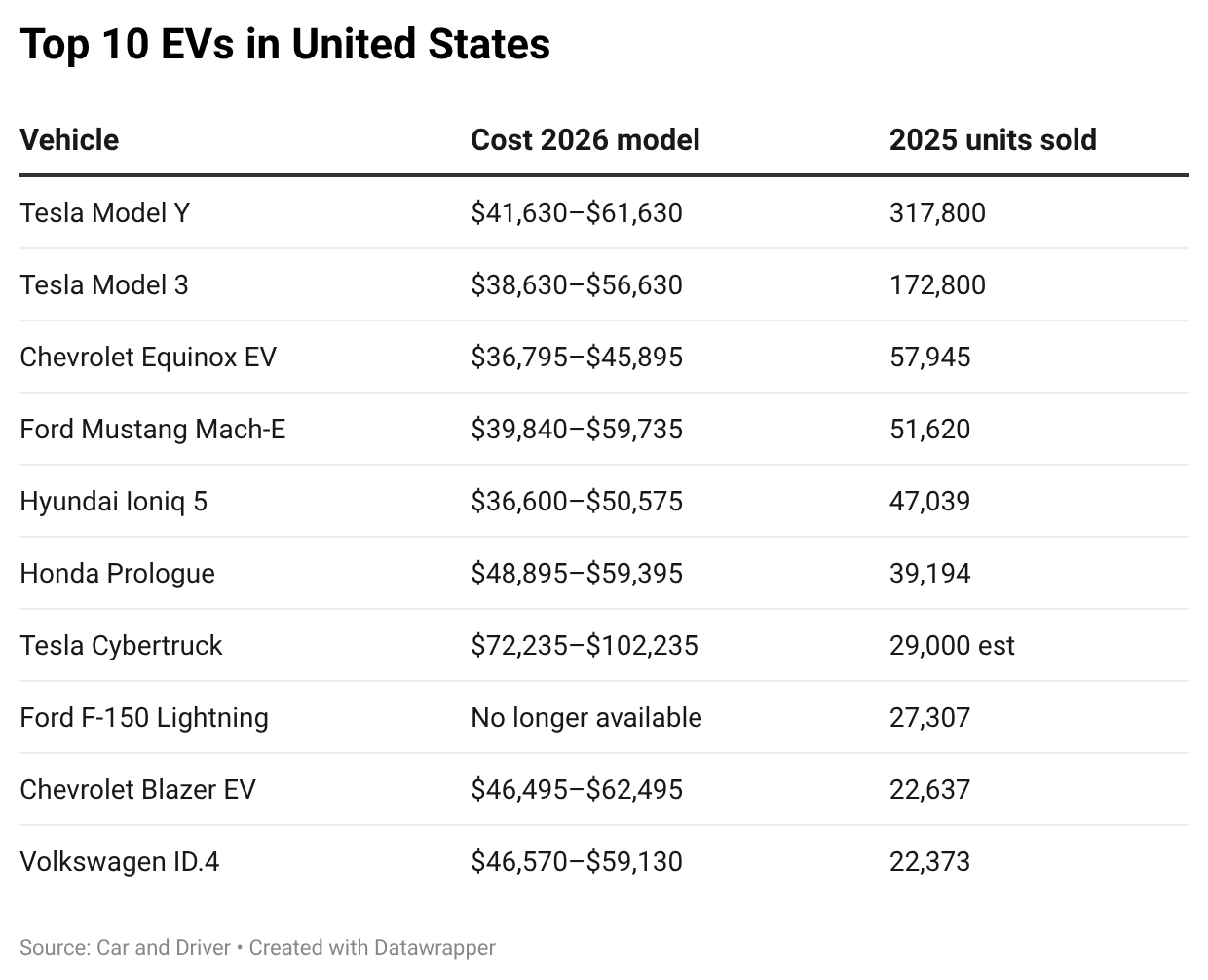
Data for the top 10 EVs in the US based on units sold in 2025 from caranddriver.com
And the cost to charge an EV is significantly less than (roughly half) the cost to fill-up the tank on an internal gasoline powered car (Forbes and CNET).
EV range is now typically over 300 miles on a charge
The range of an EV on a full charge now matches the range of a typical internal combustion engine vehicle on a full tank of gas. 2026 EV models sold in the United States typically have over a 300 mile range on a full charge.
Charging at home is convenient and easy.
No more stops at a gas station. With an EV you can charge at home. If you own your home, a level 2 charger costs around $1,000 to install and will charge an EV to 80% over a couple hours while you sleep. You can also trickle charge an EV using a standard 120-volt household outlet in your garage (Level 1 charging). Trickle charging adds about 3–5 miles of range per hour, or roughly 30–40 miles overnight, which is suitable for short daily commutes. It is recommended to use a circuit that does not have other active loads to avoid tripping breakers.
The charging station network near freeways is robust and growing.
The network of charging stations has grown. There are now charging stations along freeway routes across the United States for long-distance travel. It does take a bit longer to charge an EV than to fill-up a gas tank while traveling, which balances against the time saved never stopping at a gas station around town. Personally, I take a short walk during the 20-minute recharge stops on long-distance trips - sitting for multiple hours straight has health risks.
EV lithium-ion batteries are capable of lasting over a decade.
The sale of EVs (or battery electric vehicles on the chart below) has increased over the last 6 years. We do not have 20-year old EVs that use today’s technology to gather a robust data set on how long EV batteries last.
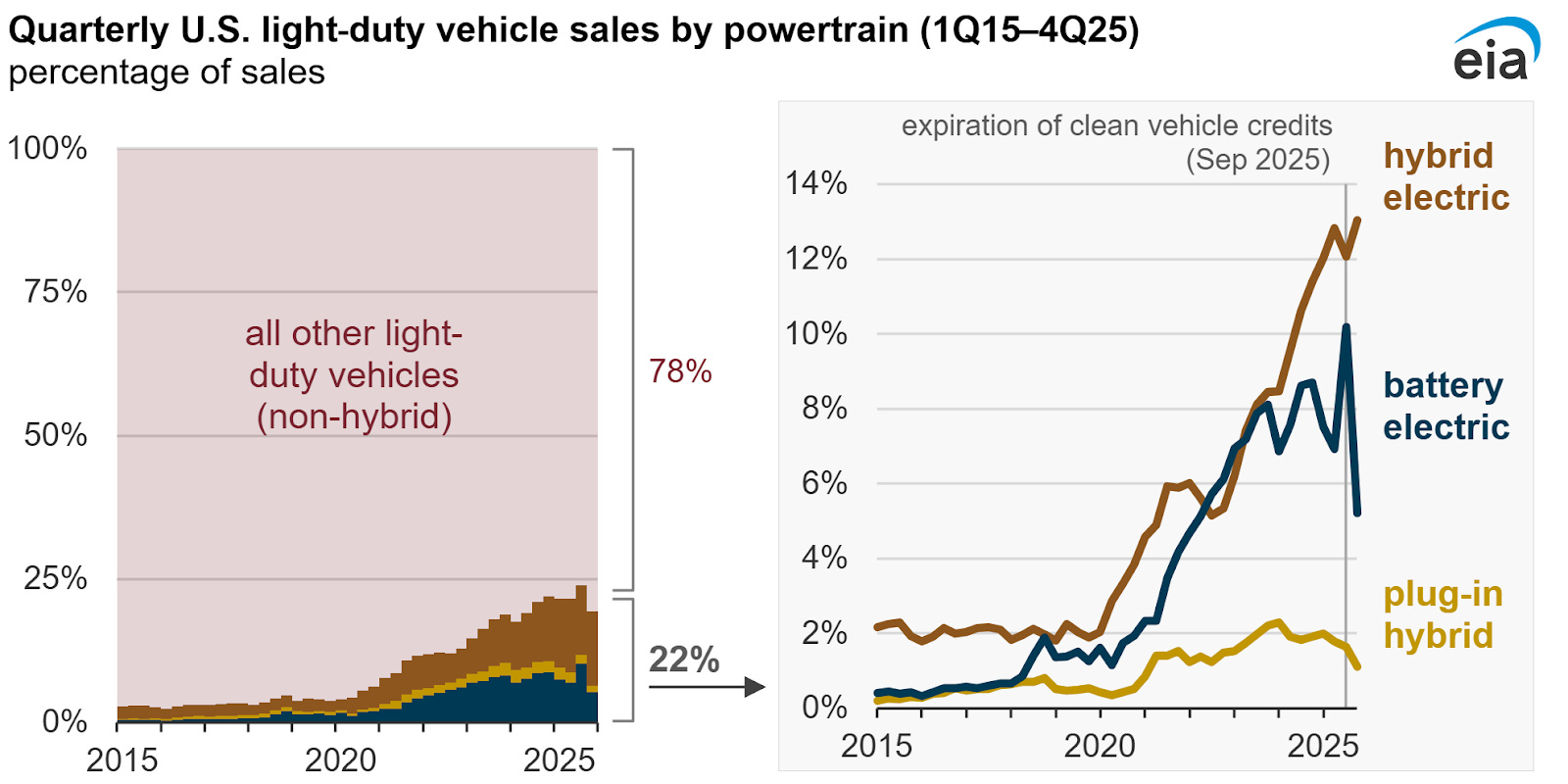
With this limitation, the current data suggests 10 to 20 years is a reasonable expectation for the life of an EV battery. There is some drop-off in range as the battery ages, but the car keeps functioning unlike when a timing belt breaks or a head gasket fails in an internal combustion engine. While there are only a limited number of EVs older than 10 years old, and the battery technology has advanced since these cars were produced, they do offer a window into what to expect. Based on data from the research firm Recurrent, “among EVs that are 10 years old or older, only 8.5% have ever had a battery replacement. More than 90% of them are still on their original battery.” (NPR, March 2 2026)
And EVs require less maintenance than internal combustion engine or hybrid vehicles. Tires on an EV may wear out faster due to vehicle weight, but this cost is offset by the lack of oil changes and the lack of wear caused by exploding gasoline in tightly engineered cylinders in an internal combustion engine.
Is my choice of vehicle important?
The transportation sector is the largest source of greenhouse gas emissions in the United States (in 2022 - USEPA). And within the Transportation Sector, light-duty vehicles (cars and pickups most people drive) account for over half of the transportation related greenhouse gas emissions.
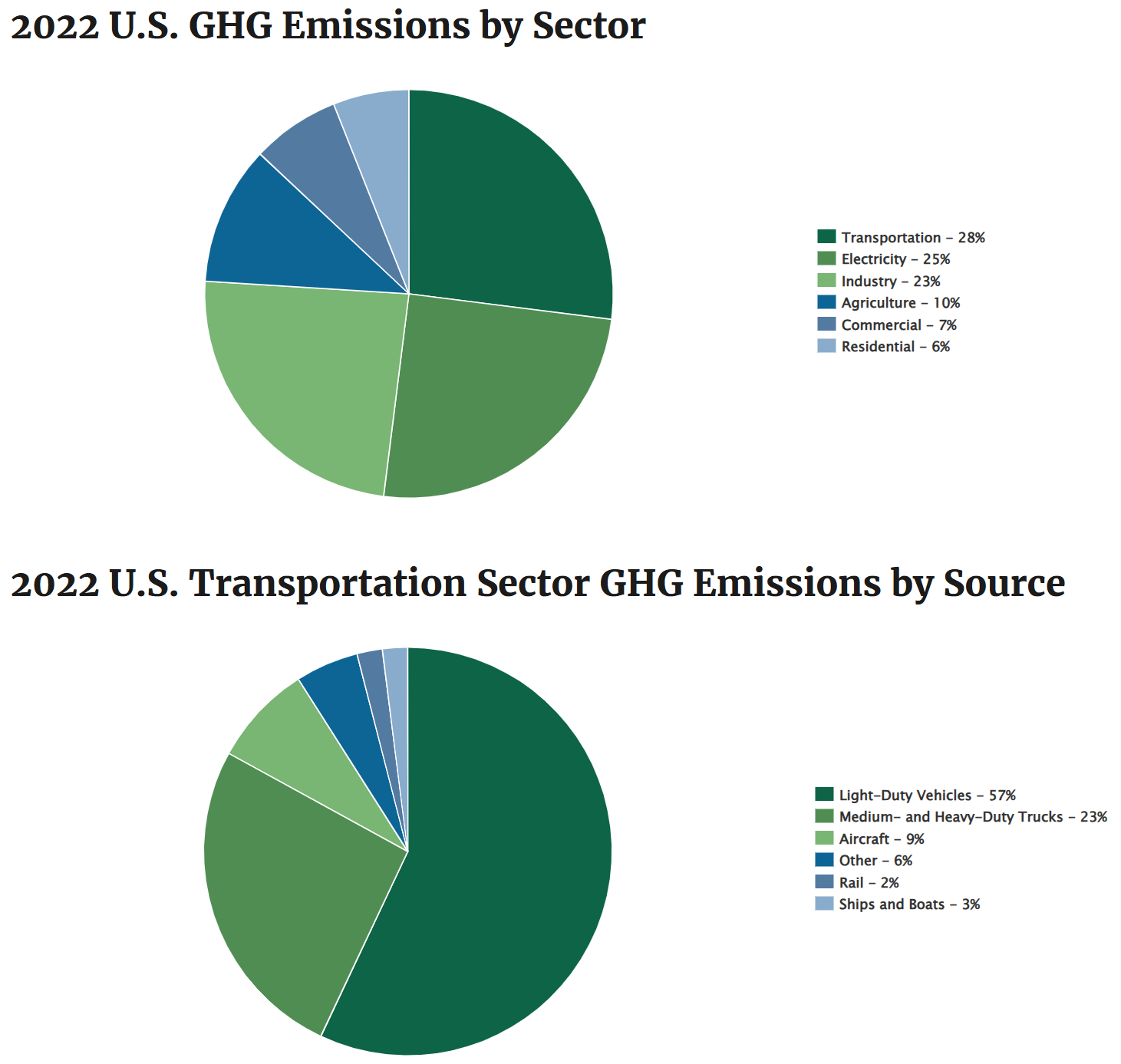
To reduce greenhouse gas emissions in the United States requires that individual driving habits change. And we have the technology, infrastructure and available automobile models today that enables this change.
And, yes, EVs have lower emissions than internal combustion engines.
It may appear that changing from an internal combustion engine to a battery electric vehicle simply changes the fuel you are using to power the vehicle - gasoline to electricity. But this shift also significantly reduces the amount of greenhouse gas emissions from your travel.
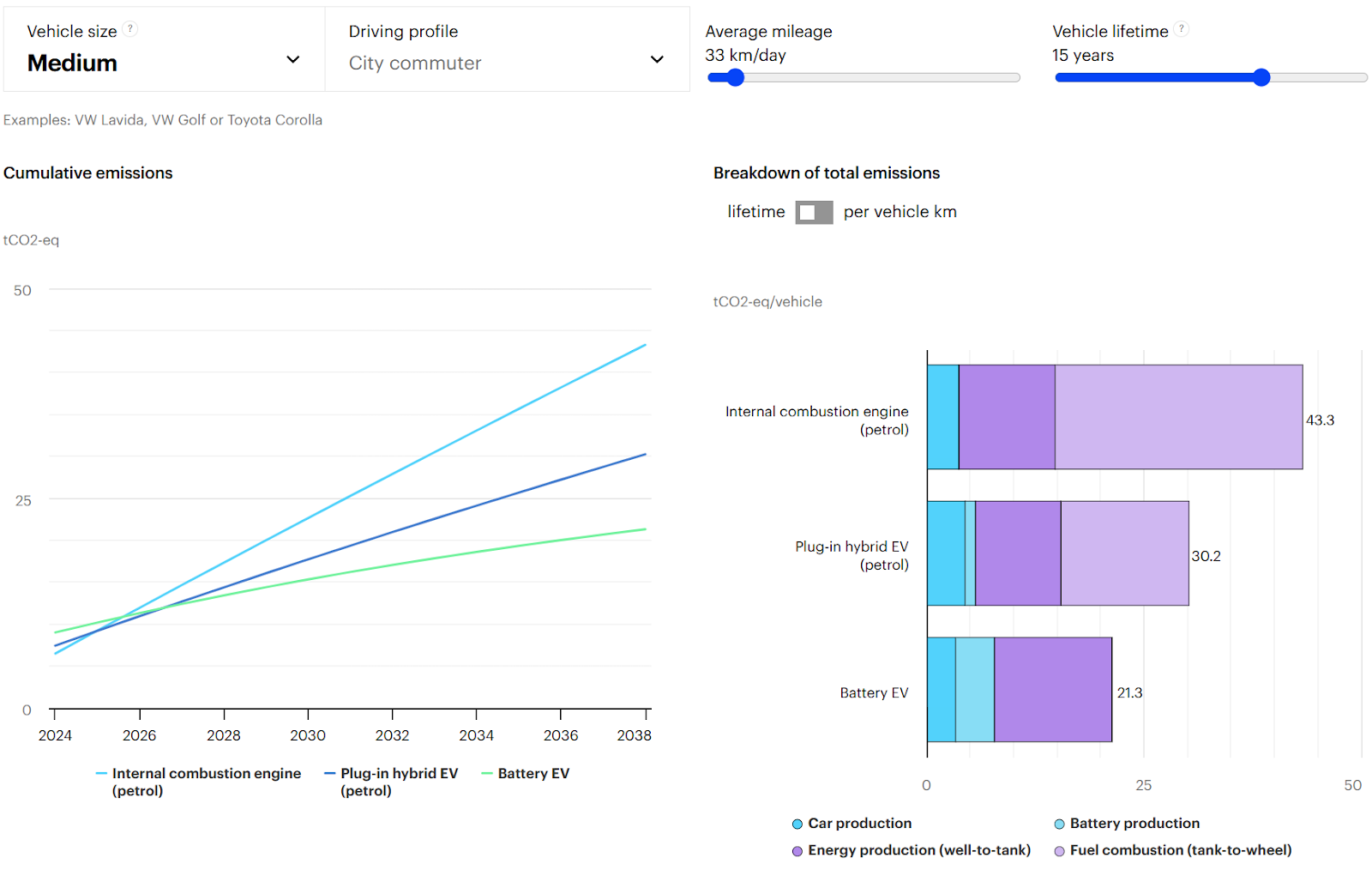
A life cycle assessment is a method to evaluate the impact of a good or service over the entire lifetime of a car (or any good or service) - including production, transportation, sales, use, and disposal or reuse. When we look at the life cycle assessment of EVs, we observe higher emissions during production of the battery in the EV in comparison to the production of an internal combustion car. However, in a short period of time the lower emissions from driving the EV lead to an overall lower emission from the EV. This is true across different mixes of electric generation across the United States. Electric vehicles cause less greenhouse gas emissions.
The International Energy Agency (IEA) provides a tool that compares the life cycle assessment for comparable internal combustion engine vehicles, plug-in hybrid vehicles, and full battery electric vehicles (EVs). Here is the IEA output for a medium-sized car used for city commuting (e.g. a Hyundai Ionic5 EV or a Honda Accord). Note that within two years the internal combustion engine option creates the most emissions of greenhouse gases (tCO2e or “tons of carbon dioxide equivalent emissions”).
Ranking our options to reduce our emissions
Live without a car
Drive an electric vehicle
Drive a hybrid ranked by highest fuel efficiency
Drive an internal combustion engine vehicle again ranked by fuel efficiency
What to do now?
It is important to understand the cues and the process that impact your actions when you buy a car. Each person is different, so this does take some exploration of your own behavior. Typically, when your existing car hits the end of its useful life (at least partially unexpectedly) or when you land that new job that requires that you buy reliable transportation, you need to have some homework already completed. For me, the cue to buy my next car has been when I unexpectedly have a repair bill on my existing car and the estimate comes in well over the value of the car itself. At that point, I shop and buy over a rather short period of time.
To assure your next car purchase aligns with your values, complete some homework before your cue to buy a new car.
Ask friends how they like their EV and what they’d recommend; ask friends about any concerns you have
Test drive a few EVs, either a friend’s or through a dealership
Explore charging options where you live; if you own a home, examine the cost of upgrading electric infrastructure in your garage.
Currently 52% of Americans are concerned or alarmed about climate change. But only 8% of new car sales in the United States are EVs and another 14% hybrids or plug-in hybrids. Any policy change to shift this ratio will be focused on requiring or coercing people to buy an EV (or a hybrid as an alternative). We can already make the change over to drive an EV today without waiting for policies that require or incentivize this choice.
Buying another new internal combustion engine car impacts our collective emissions trajectory for years to come. A review of 50,000 junked cars in 2023 provided an average lifespan of a vehicle in the US of 16.6 years. So a new internal combustion engine vehicle bought in 2026 in the US will probably burn gasoline through 2042.
Today EVs are affordable, practical, and cleaner than traditional internal combustion engine vehicles. We don’t need to wait for a new law, a new technology or a new incentive. Our actions can help reduce greenhouse gas emissions.
Jim
Affordability is absolutely relative, and it’s arguable that most new vehicles are a stretch for the average American household (although a good chunk of that can be attributed to marketing by auto manufacturers). However, used cars, and especially used EVs, can be a compelling option. EVs coming off lease are a growing subset, and they are generally significantly less expensive than new vehicles.
We drive our Equinox EV approximately 90% of the time, with our PHEV the remaining 10%. As a result, our expenses for gasoline are almost zero, and overall charging costs are much much lower than our previous all-gasoline costs. We also tend to charge up when our solar panels are productive, so that we’re not tapping into Duke Energy’s fossil-fueled grid. Every little bit helps wrt minimizing our overall emissions.
I’m mostly in agreement on EV. “Affordable”, however, is a relative term. My wife and I are not in a financial position to buy an EV. We did get rid of one of our two internal combustion vehicles a few years ago and now we share the remaining one. We reduce our trips by combining errands into one trip whenever possible. Fortunately, we live in an area where most of the places that we need to go to are close by. I would bike around more, but the infrastructure for bike riding is nonexistent out our way. There also is no convenient bus route for connecting to the places that we want to go to. All that being said, I know that we have significantly reduced our travel by moving to one car and combining trips.
EV’s are a step in the right direction, but certainly not without their own issues. Materials used to make them, problems with battery safety, disposal, etc. are all concerns when it comes to stewardship of our planet. What about hydrogen powered vehicles? I have heard a little about that possibility, but not much of late.