

Carbon dioxide removal, often referred to by the acronym CDR, is an action which removes carbon dioxide from the atmosphere and stores the carbon for thousands of years isolated from the atmosphere. This is related to “negative emission technology” or NET, which is a technology used for carbon dioxide removal. As discussed earlier, carbon dioxide removal is different from a “carbon offset” which is a mechanism to buy the credit for the reduction in emissions from another entity’s actions.
Current carbon dioxide removal technologies address the following shortcomings discussed in the post on carbon offsets:
Permanence: Carbon can be stored for thousands of years in deep rock formations, in the deep oceans, and in forms of carbon that do not readily return to the atmosphere as carbon dioxide (for example biochar in soils or carbonate rock minerals.) As a note on terminology, “leakage” from a carbon dioxide removal project can refer to a problem with “permanence.” As an example, if carbon dioxide is stored in a deep geologic formations and some of the carbon dioxide “leaks” out of the reservoir and back into the atmosphere, this problem is related to the “permanence” of storage (often referred to as durability and duration of storage in carbon dioxide removal literature.) This is different from “leakage” discussed below and in the previous post.
Avoidance of Double Counting: Whoever pays for the carbon dioxide removal can take credit for the removal. This problem can be addressed with regulated or externally certified markets so that each payment for removal is actually fulfilled and the removal credit is not sold to two entities.
Additionality: For carbon dioxide removal, each ton of carbon dioxide removed would not have been removed if the service was not paid for - so the service is “additional”. This takes regulation or certification, oversight and management to assure that the methods truly account for new removal of carbon atoms from the atmosphere, and that all emissions caused by removing the carbon dioxide are also removed at time the carbon dioxide is removed.
Leakage: For carbon offsets, leakage can occur if carbon dioxide emissions are simply shifted from one location to another location outside the boundaries of the project. An example of leakage we explored was a carbon offset sold for not removing the trees from a specific area of forest. If the offset simply shifted the logging operation to the next square mile of forest without reducing the demand for timber, the project has “leakage” and does not actually reduce total emissions. This problem is not an issue with most carbon dioxide removal projects unless the carbon dioxide removal is used as a way to justify further emissions from other sources such as emissions from air travel or emissions from my diet.
Well designed carbon dioxide removal projects can address all these concerns.
There are numerous methods of carbon dioxide removal currently being explored and developed for carbon dioxide removal often lumped by technology (e.g. enhanced mineralization) or by where the carbon atoms are sequestered (ocean, land, subsurface.) Here is a graphic from NOAA with a few of the negative emission technologies currently being explored:
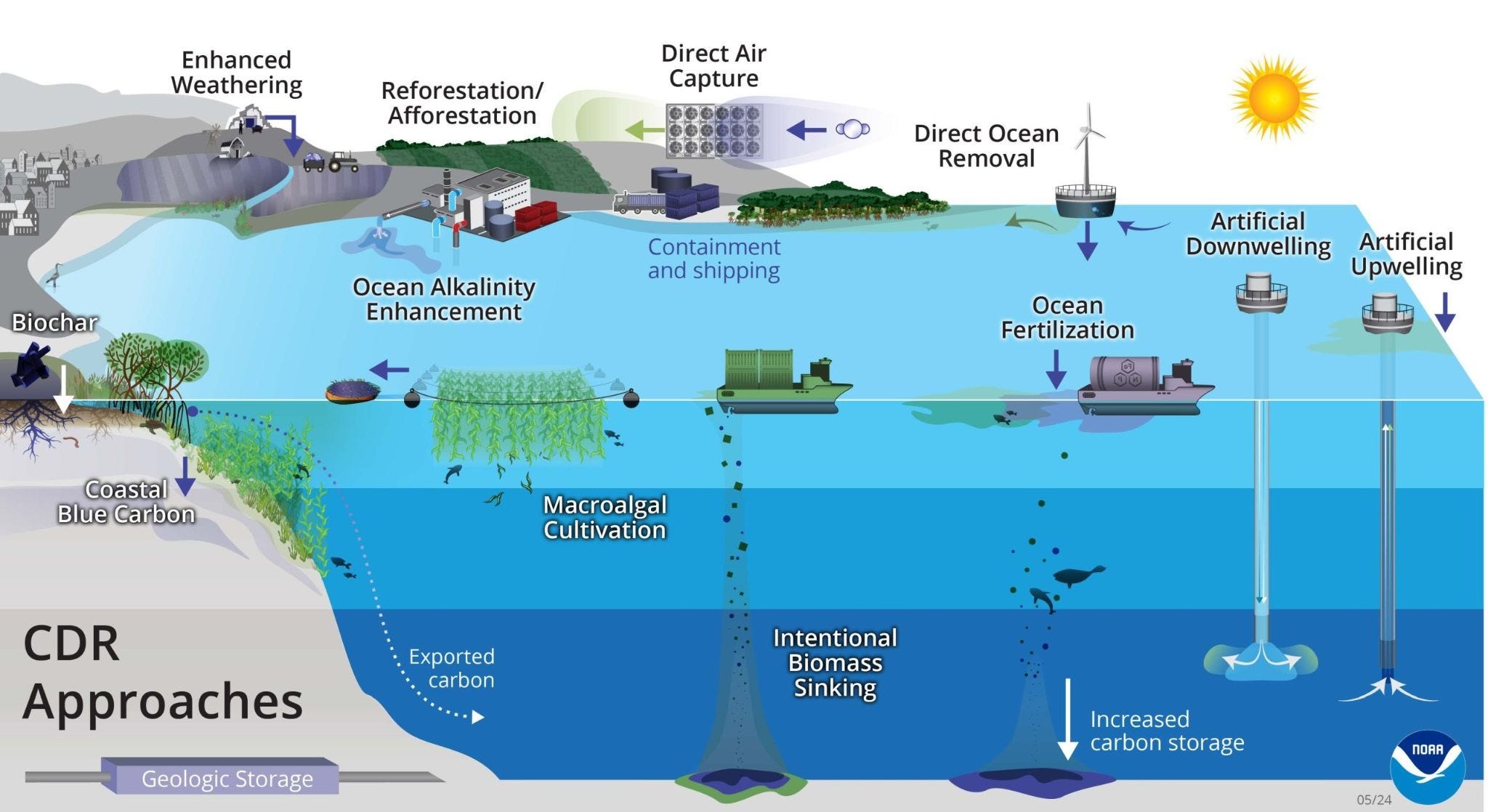
(Image Credit: Sarah Battle, NOAA)
Each technology is intriguing and has complexities worth discussion. And each of these technologies could individually fill a blog post. It is possible to remove carbon dioxide from the geochemical systems in a way that the carbon no longer cycles into the atmosphere as carbon dioxide (or methane) – there are methods which address permanence, avoidance of double counting, leakage and additionality. If you are interested in learning more about the technologies, you can start with these links:
IPCC Sixth Assessment Report WGIII CDR Factsheet
USDOE 2025 report: Carbon Dioxide Removal: Purpose, Approaches, and Recommendations
The question I bumped into while writing this post is not “Can carbon dioxide removal be accomplished?” Instead, I was challenged with the question “Should individuals pay for carbon dioxide removal as a method to offset the emissions that we cause?” I started writing this post with the commitment that the answer was “Yes, we can pay for carbon dioxide removal to counter emissions we choose to cause.” I planned to provide links for people to use to purchase carbon dioxide removal. Believing that the answer was “yes” for some time before writing this post, in 2022 I bought carbon dioxide removal from ClimeWorks to remove carbon dioxide from the atmosphere and mineralize the carbon dioxide in basalts where it will remain out of the atmosphere probably for millions of years.
But my reading on carbon dioxide removal has changed my opinion. I still hold that carbon dioxide removal or negative emissions technologies will be required as part of our collective response to climate change globally, but I now hold that individuals should focus on the deep cuts in emissions and not on attempting to justify the emissions from their air travel overseas by purchasing carbon dioxide removal as a service. Deep cuts in emissions are required, and that involves the personal behavior change I am writing about in co2mmit. Carbon dioxide removal (CDR) is expected to be needed for a global response, but individuals should focus on changing behaviors that lead to the deep cuts in our emissions. Individuals can be a part of this process, paying for carbon dioxide removal as a service. But this purchase does not eliminate our offset the emissions we cause.
The Intergovernmental Panel on Climate change (IPCC) states that “CDR cannot substitute for immediate and deep emissions reductions, but it is part of all modelled scenarios that limit global warming to 2°or lower by 2100.” “CDR {carbon dioxide removal} is not a substitute for deep emissions reductions, but it is an important tool that should be deployed in tandem with other mitigation methods.” “Particularly, CDR is needed to counterbalance emissions from difficult-to-decarbonise sectors, such as industry, long distance transportation, and agriculture.”
A 2019 academic paper which impacted my views made a case to separate emissions reductions from carbon dioxide removal. (McLaren et al. 2019 doi: 10.3389/fclim.2019.00004) The authors open their paper by stating that
“Targets and accounting for negative emissions should be explicitly set and managed separately from existing and future targets for emissions reduction. Failure to make such a separation has already hampered climate policy, exaggerating the expected future contribution of negative emissions in climate models, while also obscuring the extent and pace of the investment needed to deliver negative emissions.”
The authors continue stating that they “see clear evidence that emissions reductions can be deterred or delayed by efforts and suggestions to use NETs {negative emission technologies} to sustain fossil fuel use… substituting negative emissions for emissions reduction could be harmful in itself. Making promises of future negative emissions, instead of reducing emissions now, is even more risky.” “Carbon trading is easily distorted by powerful economic interests, and typically permits luxury emissions while constraining the demands of the poorest.”
So I will focus back on exploring ways to cut our personal emissions.
I support the solid work being done by many companies that are exploring ways to remove carbon dioxide from the atmosphere. And I accept modeling from the IPCC that these technologies will be required as we appear to be over shooting our emissions targets. But these technologies will be needed to accommodate the most recalcitrant emissions from actions like making steel and growing our food. These technologies will not substitute for the deep cuts to emissions which are directly related to our individual behaviors. And these technologies should not be used as a substitute for changes in our diet, reductions in our air travel, the choice of our vehicle or our driving habits.
If individuals want to pay for carbon dioxide removal, that can be viewed much like a charitable donation–a payment for something we value. But payment for carbon dioxide removal should not be viewed as a personal mechanism to justify higher emissions.
This is both a complex moral problem and also a pragmatic climate mitigation problem. I have come down on the side which focuses on the immediacy of our need for deep cuts to our emissions. As I’ve discussed before, we can not continue waiting to cut our own carbon emissions.
Jim