

Friends active in climate—people I deeply respect—have told me that “Climate change is a systemic issue that requires fundamental changes to our laws, regulations, and the grid. Personal change is nice but not critical, it doesn’t fix the systemic issue.”
Their conclusion? Personal change is nice, but just not that important.
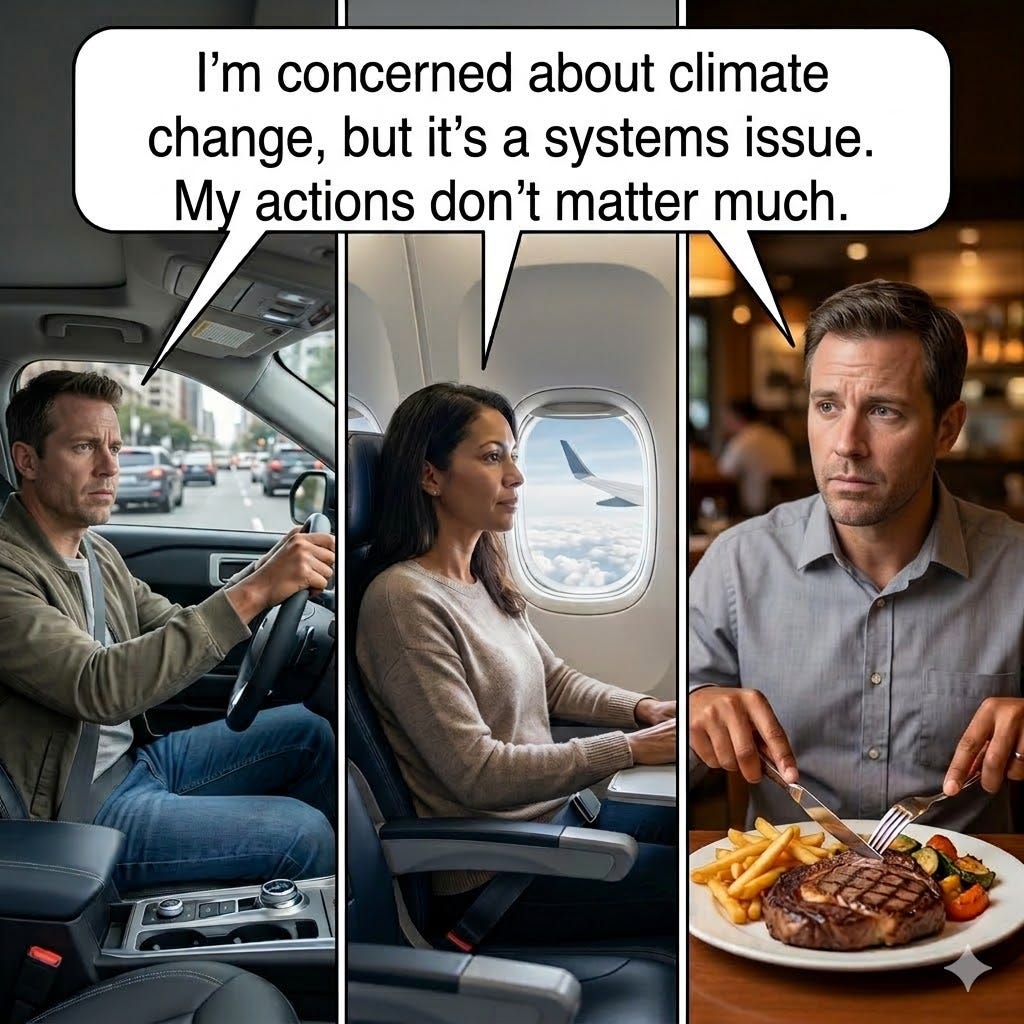
Almost all of the same climate-active friends have made personal behavior changes to reduce their emissions. They are more likely to have installed solar panels, bought an EV or hybrid, or reduced their meat consumption. Some conveniently skip some high-impact changes they don’t want to make—like giving up beef or flying less.
Let’s start this discussion with a point of agreement: We absolutely do need systemic change. We need better laws, regulations, zoning ordinances, and policies.
But this is not an either/or conversation. We must advocate for better policy and reduce our personal emissions. Taking action to reduce our greenhouse gas footprint doesn’t require a new law or a change to the local zoning ordinance. Our purchase decisions are completely in our control. There are real options available to us that emit less. And while some actions require upfront capital, others save money—like eating a vegetarian diet or choosing to avoid flying.
We can not continue waiting
It has been over 40 years since Dr. Carl Sagan testified before Congress in 1985, and 38 years since Dr. James Hansen warned the US Senate in 1988. Scientists have put forward compelling and digestible overviews of the science and the projected impacts. Yet in the United States we have failed to pass a legal framework limiting greenhouse gas emissions. It is not as simple as waiting for Democrats to control the US House, Senate and White House. During the first two years of every Democratic President since the 1980s—the Clinton, Obama, and Biden administrations—Democrats controlled the House, the Senate, and the White House and there was no legal structure put in place to regulate greenhouse gas emissions. Instead Democrat administrations relied on the endangerment finding to use the Clean Air Act to attempt limited regulation of power plants or fuel efficiency standards.
We absolutely need to continue to advocate for better laws and policy, but we should not wait to cut our emissions. If the 52% of Americans who are concerned or alarmed about climate change acted to reduce the emissions our purchases cause, we would make a significant difference. We would shift US markets for goods and services, and fundamentally change the political will in Congress. We don’t need to wait for a federal law or tax rebate.
Who takes actions based on moral choices?
Let’s examine who we expect to act:
The government (to pass laws)
Corporations (to reduce emissions and sell lower emission products)
People (to avoid spending money on choices that cause emissions)
Which of these actors have the agency to make moral choices beyond financial concerns?
Corporations are not moral actors. Corporations shield individual owners from the consequences of the actions of the company - this is the antithesis of establishing a moral actor. Even when corporations commit to green or sustainable goals, they readily drop these commitments when it is beneficial to grow earnings or shareholder value. Take for example GM: as recently as 2024, GM said “GM has committed to electrifying 50% of its fleet by 2030. By 2035, 100% of our automotive fleet, for passenger and light-duty vehicles, will be electric.” But then in 2026 GM announced a $6 billion charge against earnings to reduce its planned EV production. GM’s reversal is sometimes linked to shifting government incentives for EVs, but it seems more logical that the shift is ultimately linked to the lack of growth of EV new car sales in the United States. Ford has a similar trajectory.
We cannot expect corporations to lead; their positions depend on the purchases of their customers and on creating shareholder value (profit). Maximizing shareholder value is not a bad thing, but frequently it does not align with climate goals.
The Government rarely leads. In a democracy, politicians follow the public or the donors to their Political Action Committees (PACs). Relying on the government to make energy more expensive, tell us what to eat, or restrict air travel can create a populist pushback against the “solution” if we are not already taking these actions. (Take Australia as an example.)
You and I Are the Moral Actors
You and I have moral agency. We have the freedom to make choices and act according to our values.
When more people voluntarily act we will reduce emissions, boost markets for low-emissions goods, and change the calculation politicians make when evaluating support for climate requirements. This is not the only change we need - but it is the only action completely in our control. And it is an important wedge in the broad range of emissions reductions we need. A wedge completely in our control, today.
We must stop rationalizing our high-emission choices.
A climate-active friend told me that his flight oversees will take off whether or not he bought a ticket, so his personal choice to fly overseas simply does not matter. But the decrease in commercial aircraft operations during and after the COVID-19 shutdown proves otherwise: when people stopped buying tickets, airlines responded by reducing flights. And as people started buying tickets again, airlines resumed their flights. The following graph covers the response of airlines to the reduced number of tickets sold in response to COVID.
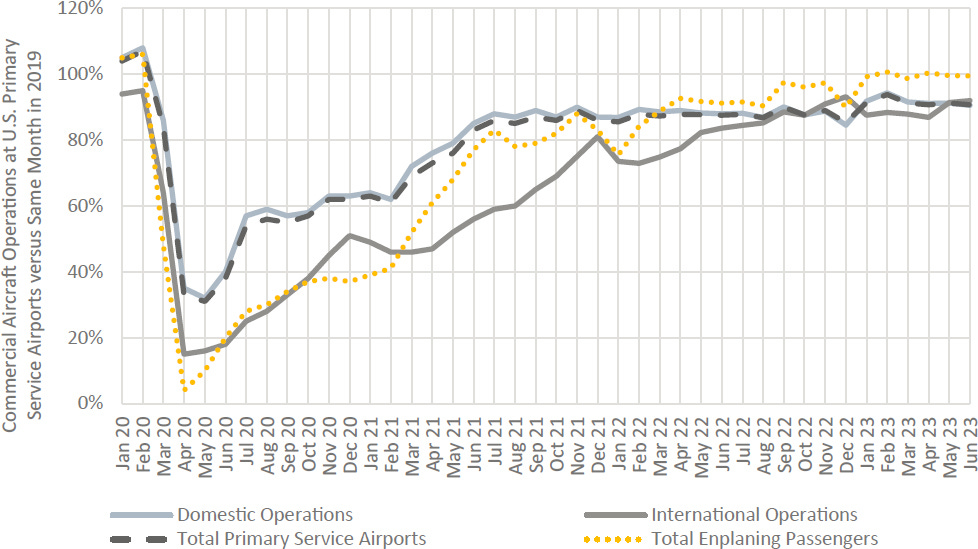
This demand side argument holds across many markets: airline flights, EV car sales, restaurants offering vegetarian menu options. We, the consumers, have more agency than we understand.
“The chief task in life is simply this: to identify and separate matters so that I can say clearly to myself which are externals not under my control, and which have to do with the choices I actually control. Where then do I look for good and evil? Not to uncontrollable externals, but within myself to the choices that are my own…”
(Epictetus, Discourses. 2.5.4-5)
While we advocate for better policy, it is essential that we also focus attention on climate mitigation in our direct control - reducing the emissions caused by our actions.
Jim
The “systemic change” comment can be a way to rationalize not committing to personal change. While systemic change may accomplish bigger needed improvements, we can’t rationalize away our wasteful personal habits that collectively make a substantial hit on climate change. We can all individually do better, one change at a time.
True. An all of the above approach is best. I'd also add that here in Asheville our local government has been very responsive to our concerns about reducing carbon. As just one example, the city and county installed large solar arrays on most many government buildings (including schools). We can affect governmental change on a local level. Maybe statewide next??
For those of us who can afford it, buy an electric car or at least a plug-in hybrid. As a bonus, Duke will reimburse you for the level 2 charger that you have installed at your home.
Also, buy a heat pump water heater. Duke may provide rebate money for this (if you're switching from an standard electric tank). A heat pump water heater is 3 to 4 times more efficient than a standard electric and twice as efficient than a gas water heater. Switching to a heat pump water heater will pay for itself more quickly than just about anything else you can do to your home.