

Greenhouse gas emissions are caused by the actions of the 8.3 billion people who live on the Earth. Without us, there would be no coal mines, no oil refineries, no airplanes, no automobiles and no gas furnaces. Collectively, we cause fossil fuels to be burned for energy, we cause land use changes, we buy the products from 1 ½ billion cows currently being raised.
Each of us does not cause the same amount of emissions. People in the top 10% of personal income globally cause almost half of our global greenhouse gas emissions.

People with higher incomes cause more emissions. I say income, though in developing economies it’s difficult to accurately measure income so economists often measure expenditures (or consumption) as a more reliable proxy for welfare. I will talk about “income” as it is a term we use in America, but recognize that this actually translates to how much a person is able to consume for over four-fifths of the global population that live in undeveloped or developing economies.
The bar chart below divides global greenhouse gas emissions by global income deciles. Each decile represents 10% of the population. So decile 1 shows the emissions of the bottom 10% of people ranked by income, decile 2 shows the emissions from people making more than 10% of people up to 20% of people, on up to decile 10 which shows the emissions from people making more than 90% of other people in the world (data from IEA where they have engaging interactive graphics worth exploring).
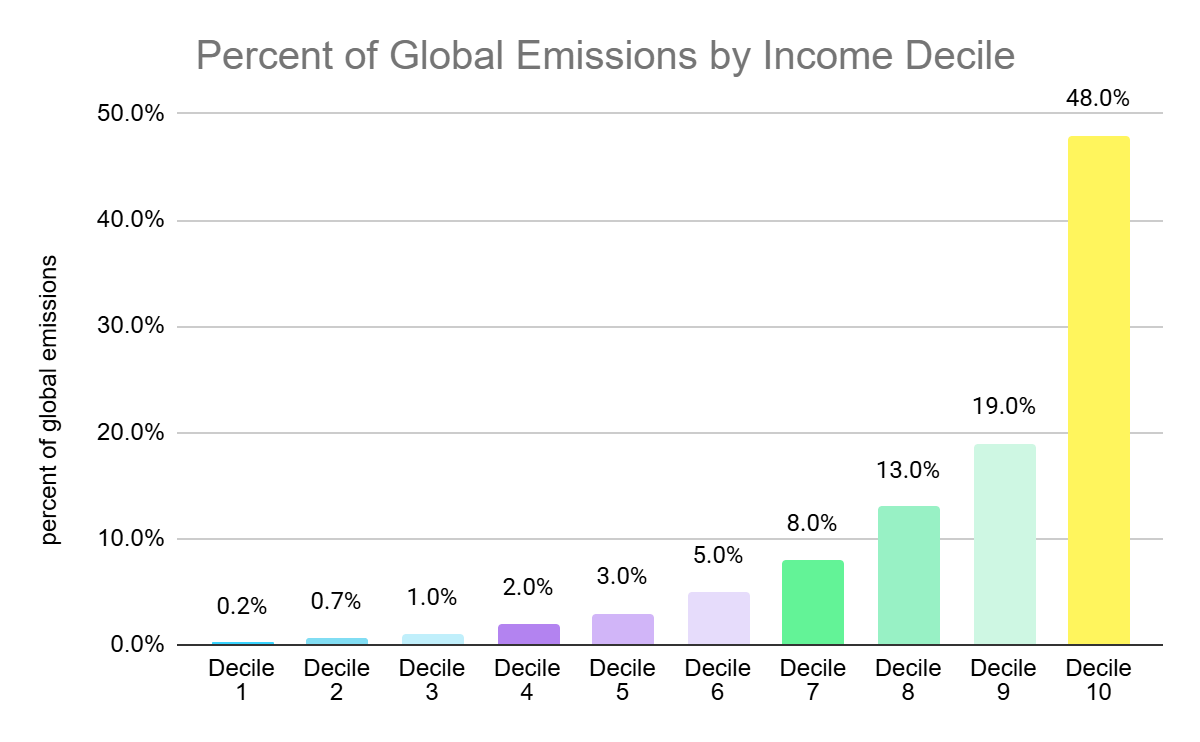
The top 10% making the highest incomes globally (decile 10) cause almost half of the greenhouse gas emissions. These are people with incomes over $54.60 per day or $19,929 per year.
The top 20% (deciles 9 and 10) emit two-thirds of the global emissions. These are people with incomes over $29.20 per day or $10,658 per year.
The poorest half of the people in the world, with incomes below the median income (Deciles 1, 2, 3, 4 and 5 combined), emit less than 10% of the greenhouse gas emissions. These are people with incomes less than $9.35 per day or $3,413 per year.
In the United States, over 80% of people have an income greater than $29.20 per day or $10,658 per year. So over 80% of Americans are in the top 10% by global income - the category responsible for almost half of the world’s greenhouse gas emissions.
(You can explore income decile data globally and by country at Our World in Data based on World Bank Poverty and Inequality Platform, 2025)
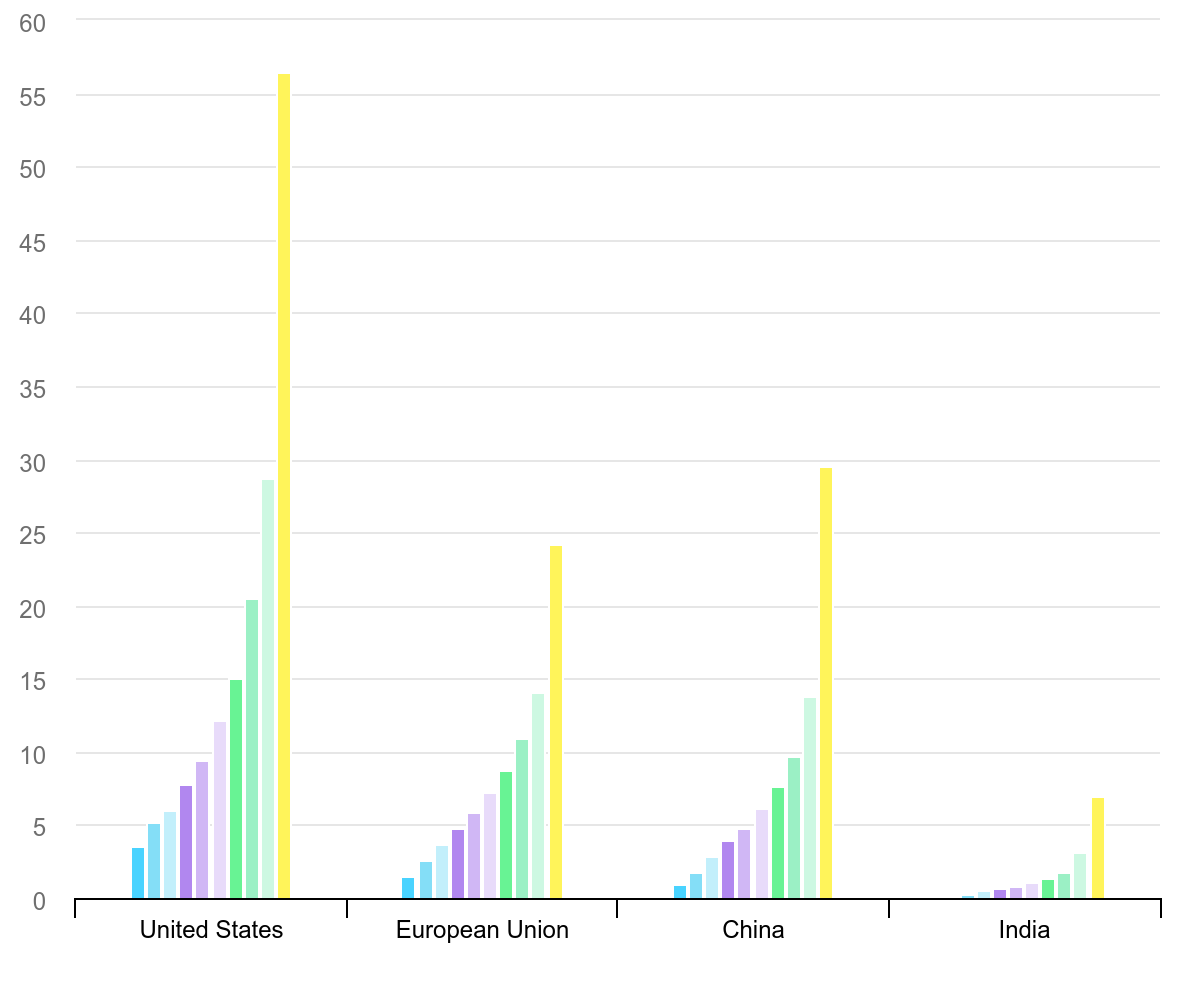
This same relationship holds within countries also: People who have higher incomes cause more greenhouse gas emissions. This is true in developed economies (e.g. United States, Europe, Japan, South Korea, Australia) as well as developing economies (e.g. China, India, all of the middle east except Israel, all of Central and South America except French Guiana). The following graphic shows the average per capita greenhouse gas emissions (tons of CO2e on the y-axis) for each income decile in the United States, European Union, China and India (source IEA):
The International Energy Agency (IEA) discussed this further in their 2023 overview titled The world’s top 1% of emitters produce over 1000 times more CO2 than the bottom 1%.
“The richest group often has the largest financial means to adopt energy-efficient and low-emissions solutions that involve high upfront costs. In doing so, they form the initial customer base that can help enable the manufacturing of these technologies to be brought to scale. For example, a large share of electric vehicles were purchased by high-income individuals at first, but as sales increase with models at varied price points, EVs are becoming more ubiquitous.”
The IEA further explored the need for behavior change in their 2021 post Do we need to change our behaviour to reach net zero by 2050?:
“But technology alone is not enough: net zero emissions in 2050 cannot happen without the consent and active support of people. In part, this involves one-off events that are not counted as behavioural changes but involve a mixture of low carbon technologies and people’s engagement, such as buying an electric vehicle (EV) or insulating a loft. However, behavioural changes – meaning adjustments in everyday life that reduce wasteful or excessive energy consumption – are also needed. They are especially important in richer parts of the world where energy intensive lifestyles are the norm. Behavioural changes include cycling or walking instead of driving, turning down heating, and going on holiday nearer to home. In addition, efforts by manufacturers to use materials more efficiently and encourage consumers to recycle can reduce energy use in industry.
Behavioural changes can and do happen. From diet to smoking to throw-away plastic packaging, past experience shows that people’s attitudes and habits are not set in stone.”
Having a higher income allows us to take more actions that reduce our emissions.
Some actions to reduce emissions require an upfront outlay of capital that takes years to recover the cost—like installing solar panels or upgrading insulation. Other choices might carry an upfront cost higher than the expected cost reductions in your monthly bills, like adding a heat pump to your HVAC system.
You might anticipate that people who make more money will then actively drive their emissions lower than people who make less money. People making more money simply have more resources to make these changes, more capital to invest.
For some people, this is the case.
But for the vast majority, this is simply not the case. Instead, people who make more money cause more greenhouse gas emissions through their purchase decisions.
“But I…” My reasons not to change
Talking to people about changing their behavior to lower their emissions, I hear a lot of reasons why people haven’t made—or feel they can’t make—specific changes. Some of these constraints are very real. Others sound like rationalizations I have used myself. They are often justifications constructed to explain our existing behavior when our behavior conflicts with with our values:
“I worked my entire career to be able to travel more when I retired. I’ll fly on lower emission planes when airlines fly them.”
“I can’t afford to upgrade the electric plugs in my garage to support an EV.”
“I really love cheese (or milk, or beef…) and I’ve always eaten it.”
“My spouse isn’t going to change, and it’s hard to change alone.”
“My actions really don’t matter if 8 billion other people don’t change.”
“I think this is a systems issue, and I’m waiting for the system to change.” (see previous post for this one)
Changing my actions is climate action
If you live in the United States and earn more than $20,000 a year, your personal emissions are likely in the top 10% globally.
The paradox is that people with the most resources available to reduce our emissions are, generally, the ones causing the most greenhouse gases.
The entire premise of CO2mmit is asking people to commit to reducing the greenhouse gases they cause. The technology and the behavioral roadmap already exist to significantly reduce our emissions. The remaining question is: will we act?
When we do change our actions and lower our emissions, we cause a real reduction in emissions, a shift in markets enhancing lower emission goods and services, and a shift in social norms regarding what those around us see people in their peer group doing. And we find that we are acting in alignment with our values.
Jim
The problem of climate denial, as with other environmental issues in the USA is political, with economic, indvidual age, and education related aspects.
The oil and gas lobbies spend close to three times what environmental groups spend to influence elections, the vast majority going to Republicans The real subsidies are in the tax code, where fossil fuel investments can now be written off in the same year they are made, generous tax credits, etc. The companies reward politicians at the state and federal level for leaning hard to favor them, and it shows up on your energy bills. We spend an inordinate amount of our dwindling national treasure to fight wars that benefit the fossil fuel companies by propping up prices, that shows up as inflation which is trending up.
The main driver for moving toward renewables is economic, the cost of wind and sunshine not varying like fuels in our unstable world. The sector will win out eventually here, as it already is internationally, China and India have put renewables in place much faster, so they will be in a better position to compete economically.
There are many more younger adults who are concerned with global warming than older Americans. Some older citizens have hope that our young people will eventually solve the problem, a convenient position that allows older folks with money to not change, while younger people are unable to buy housing, much less deploy much capital.
Our education system favors memorization over critical thinking, exhibited by a health care system that neglects the power of food vs. patented chemistry and marketing groups that push the junk food that makes is fat. We are growing a nation of people who are easily enslaved by media, which is controlled by those with money,
America is on a decline, we have chosen the wrong paths. The coming political backlash of dissatisfaction will hurt our country's stability and welfare near term.
We desparately need to tune into reality vs. the artificial stories and blatant political lies we have been fed. Vote judiciously and consistently.
thanks for the work here Jim. So my request is we keep carbon offset options on the table. My mom loves to travel but I always browbeat her to pay for the offsets of her flying so she is supporting exceptional projects like methane land fill energy generation and eliminating her impact. I agree it would be better if she just didn't do the flying but I don't think that's reasonable. Plus projects at $8.50 per ton make it very affordable. It's an easy way to absolve or guilt and these really are amazing projects that have multiple positive impacts. Happy to share where I buy mine if you like. Cheers!