

While on the road, there are two main differences between driving an EV and driving an internal combustion engine.
First, there are fewer EV charging stations. We plan our next stop as we begin each leg of our trip. It’s not difficult, especially with the Tesla map showing us a recommended charging location and how much charge the program expects us to have when we get there. But we often stop a little earlier than the app recommends - mostly because we want time out of the car getting in a 10 minute walk instead of driving for 3 hours straight, and also because we typically don’t let our battery get below 18% charge.
Second, the experience at a charging station is simply different than the experience at a gas station. When we drive our Prius instead of an EV, we stop at gas stations instead of charging stations. We pump our gas standing next to our car where we can smell the gas, visit a restroom at whatever convenience store the gas station is associated with, then we get back on the road. Gas stations in the United States make more money on food than on the low-margin gas they sell you, so we typically find a selection of sweet or salty snacks along with a wall of cold beverages priced at $1.50 to $3.00 per drink, and a fountain drink option. For fresh food options, we are lucky to find a basket of bananas, though there is no predicting how ripe the bananas will be on the day we visit. My favorite, go-to snack at these quickmarts is a bag of BOLD Chex Mix that I pretend is healthier than the potato chips. A serving has only 10% of the maximum sodium recommended in a day; but the 8 oz bag says it has 8 servings and I eat the whole bag before our next stop, so I consume 80% of my daily sodium limit within a few miles of leaving the gas station. Occasionally I may buy and eat the 13.5 oz bag, but we won’t talk about that option. Then, a little bit after filling up the tank, Celeste and I will stop at a rest area and walk around to stretch our legs.
Charging an EV takes a bit longer than filling up a gas tank, but when we combine it with our walk, we save time. We plug in and simply walk away from the car, watching our phone to see when we are done charging. We often get a walk in: outside if the weather’s nice, or inside if the charging station is next to a sizable store. While a charging stop takes longer than filling a gas tank, it does not take longer than both filling a gas tank and getting in a walk in at a second stop. We also frequently fit in a bird list on our walk. Being birders, this is a bonus for us. Charging an EV is a different routine than when filling up a gas tank. As we’ve explored what can be done in this “EV charging” routine, we’ve found ways to utilize the time. Different, yes. Longer, maybe or maybe not. And in some ways better.
Our Trip
Celeste and I drove from our home in Asheville, North Carolina to western Michigan to see our kids in July. We spent about 10 days in Michigan staying in a rental unit, then drove home.
We drove a Tesla Model Y. We started the trip with a battery charged to 90%, and we charged at Tesla Supercharger locations along the freeway until we got to our rental unit when we plugged in to trickle when we needed a charge until the trip home when we, again, relied on the network of Tesla Supercharger locations for power.
Our route took us through
Knoxville, TN
Lexington, KY
Louisville, KY
Indianapolis, IN
St Joseph/Benton Harbor, MI
Once we reached Lexington, KY many of the Tesla Supercharger locations in the Midwest are frequently in the parking lot for Meijer stores.
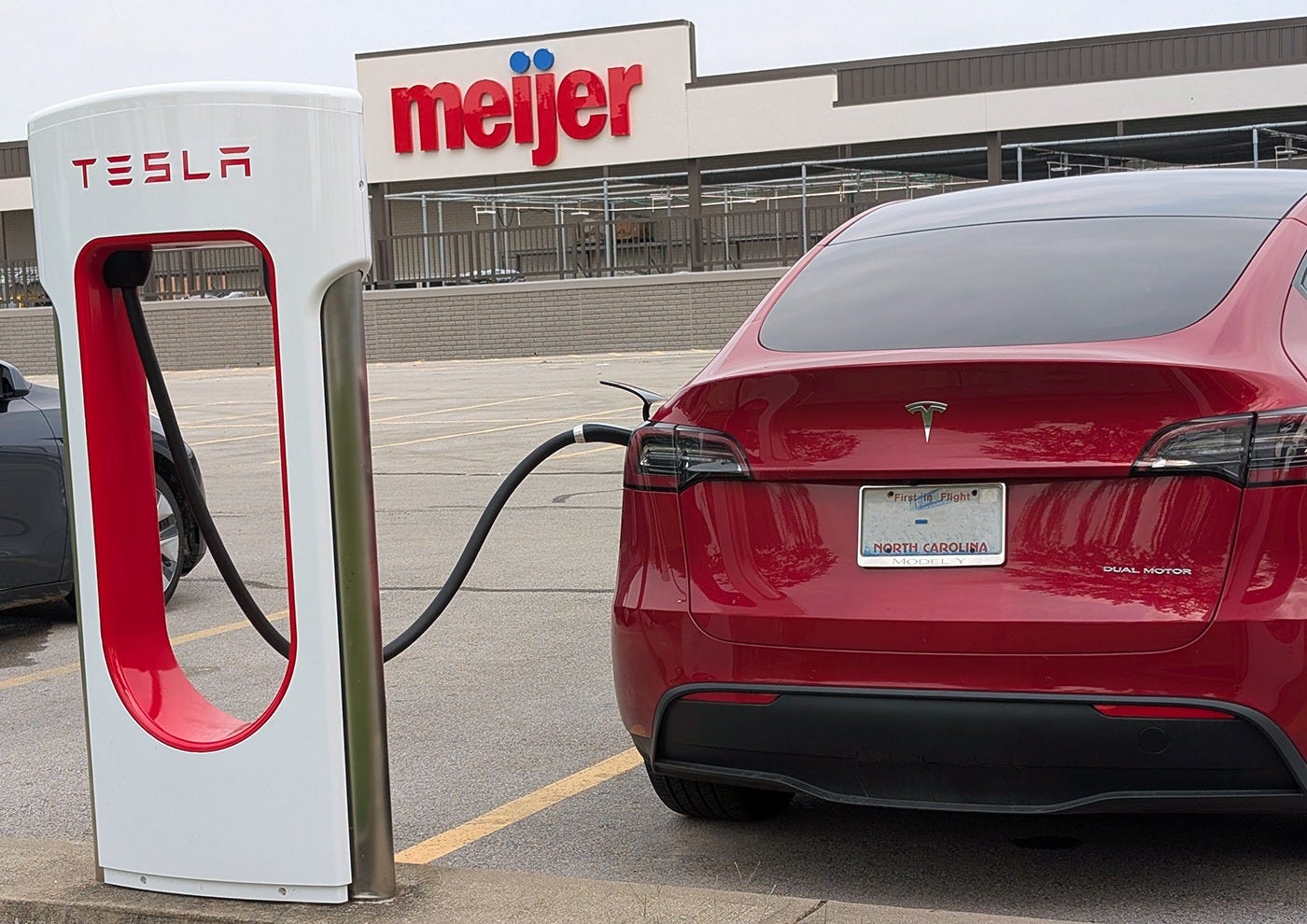
Stopping at a Meijer is a significant upgrade over a gas station quickmart. If you are unfamiliar with Meijer (e.g. if you have not lived in the Midwest), they are the model that Sam Walton used to build Walmart, except a Meijer store is cleaner, brighter, has wider aisles, and focuses more on fresh foods than a Walmart. We have never stopped at a Meijer with a bathroom so dirty we needed to walk out. (In contrast, we have lots of memories of restrooms at gas stations we wish we could forget.) And instead of a few bananas being the fruit options, there is a whole fresh produce section with blueberries, cherries, apples and so much more. We often choose a few other items we pick-up: we’ve bought kitchen towels, birthday cards, and toiletries while at Meijer charging the Tesla. Being mid-July on our trip to Michigan, we took advantage of the store’s large footprint and walked in air conditioned comfort while charging.
In Tennessee, Tesla has partnered with Buc-ees. Not our favorite place to stop as the inside of their “store” is truly chaotic. If a store could suffer from ADHD, the Buc-ees at Sevierville, Tennessee is what that would look like. But they do always have clean bathrooms. And it is impressive to see the LONG aisle of 48 Tesla Supercharger stalls. (We skipped this stop this trip, but here’s an earlier picture.)
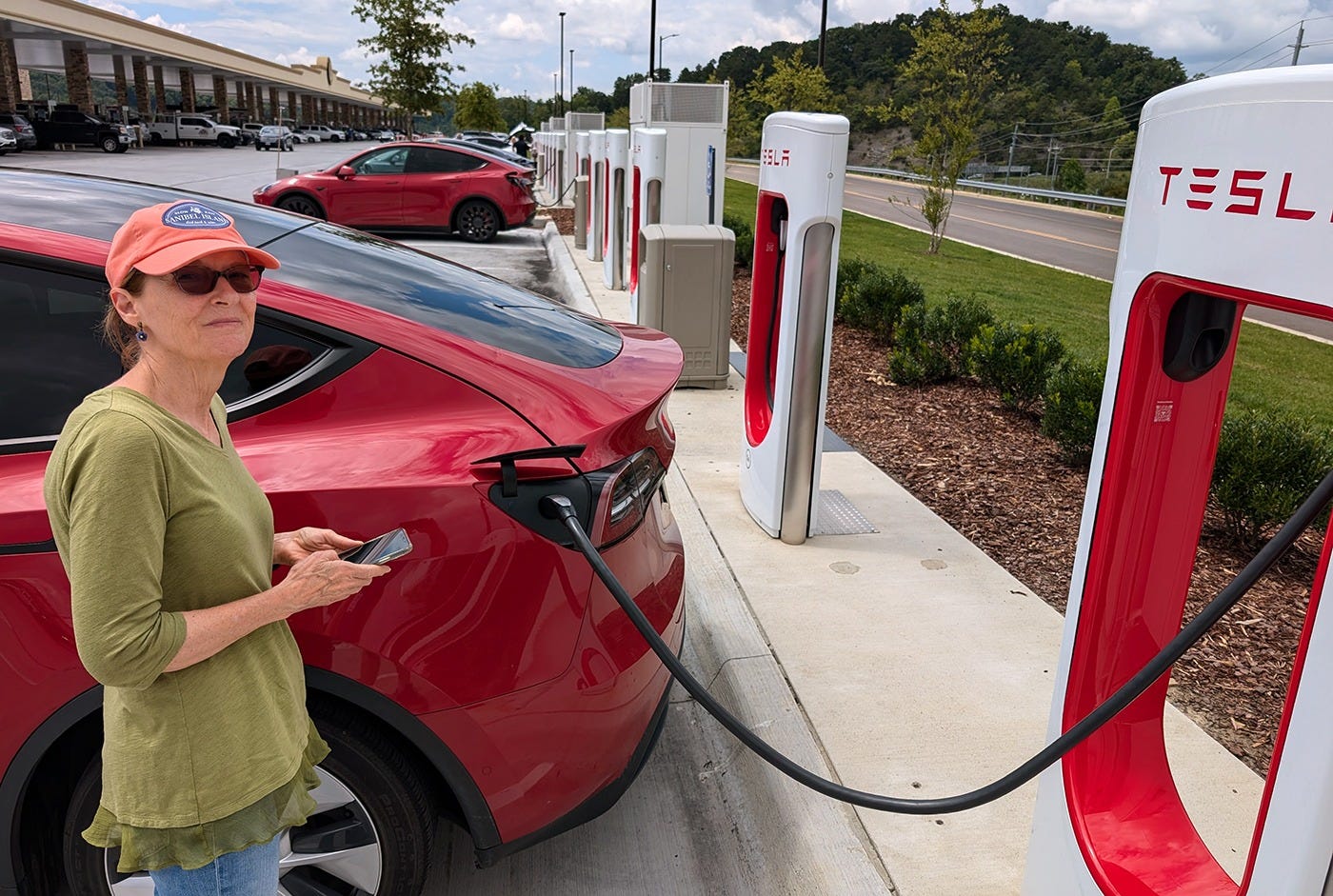
There was only one stretch where we had to be careful choosing our charging locations. Between Indianapolis, Indiana and St Joseph, Michigan there were limited charging locations adjacent to US 31, so on the way north we had to stop for charging in Kokomo, Indiana sooner than we would typically stop, but since it was sooner the charging took less time. On the way home, this gap in charging stations fit into our charging pattern so we did not need an extra stop.
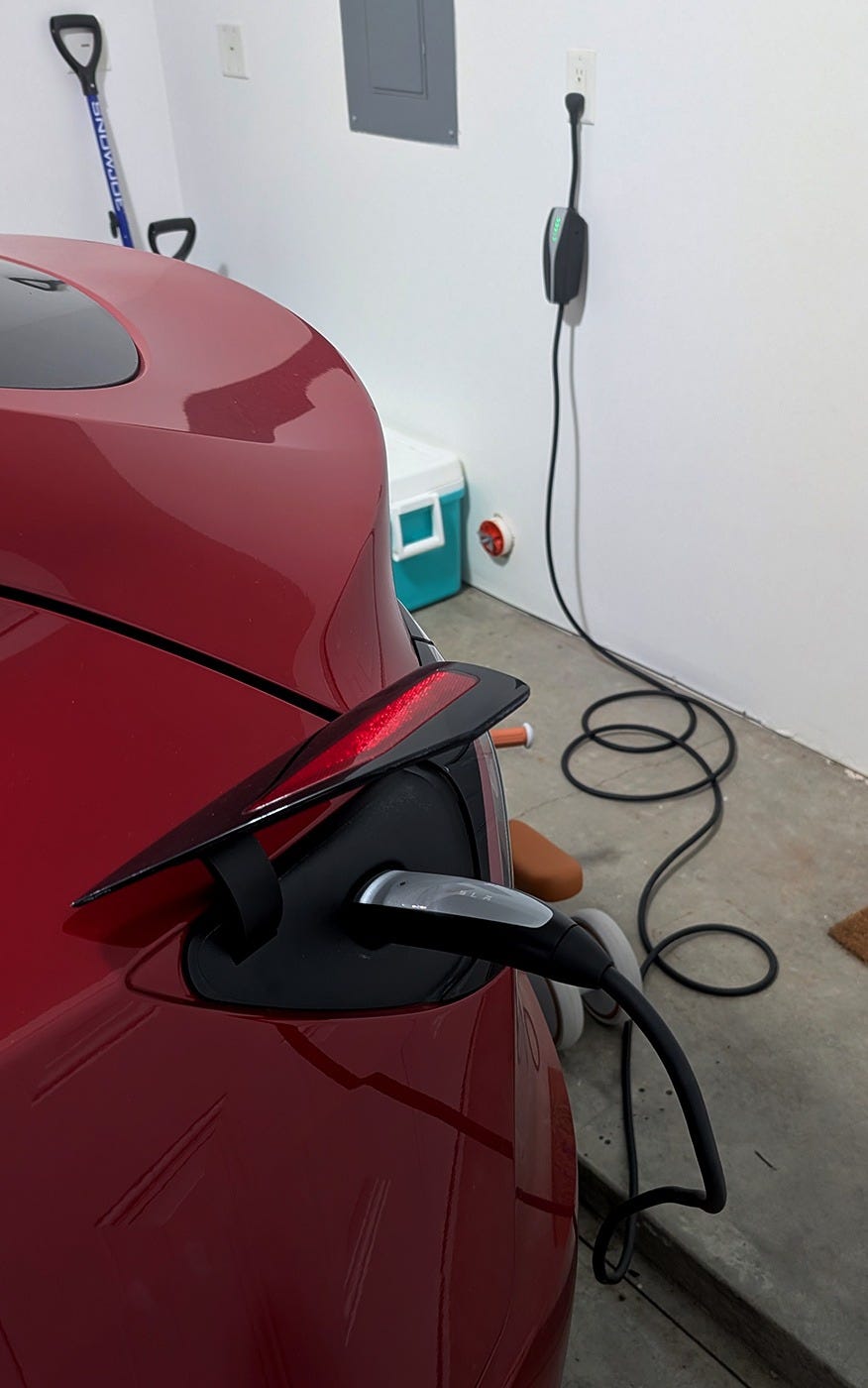
Once at our rental unit, we simply plugged the car into an outlet. Charging slowly off a standard plug on a 20 amp circuit (trickle charging) worked fine. It didn’t matter that this is a slow way to charge, as the car could charge most of the day and night.
Cost
For our entire trip, we spent $138 on electric charging at Tesla Supercharger stations and drove around 1,500 miles. With gasoline around $4.00 per gallon during our trip, our $138 would have bought 34.5 gallons of gasoline. And over our 1,500 mile trip, our fuel costs were equivalent to having an internal combustion engine (ICE) vehicle that got 43.5 miles per gallon (mpg).
There is a cost premium to charging an EV at a supercharger location while on the road. When we charge our EV at home, each kWh of electricity is charged at a lower residential rate. So daily travel near home is much cheaper than the equivalent price for gasoline in an internal combustion engine. This is particularly true for us as we installed solar panels with a capacity designed to cover driving an EV. So around town in North Carolina, the electricity to drive is virtually free (or was paid for when we installed the solar panels six years ago).
Emissions
Driving an EV reduces the emission of carbon dioxide which is a major component in the emissions from the exhaust system of a traditional internal combustion engine car. But it does not completely eliminate emissions. Driving an EV has two main benefits for emissions. The first is the lower emissions caused by running an electric motor to move the vehicle charged by our current electric grid. The actual emissions from generating the electricity depends on the mix of sources for each portion of our electric grid. More generation from solar, wind, nuclear and hydro leads to lower emission, more generation from natural gas leads to higher emissions, and more generation from coal really adds to even higher emissions. The Union of Concerned Scientists created a regional profile of the equivalent fuel efficiency for an internal combustion engine to match the emissions from an average EV (source).

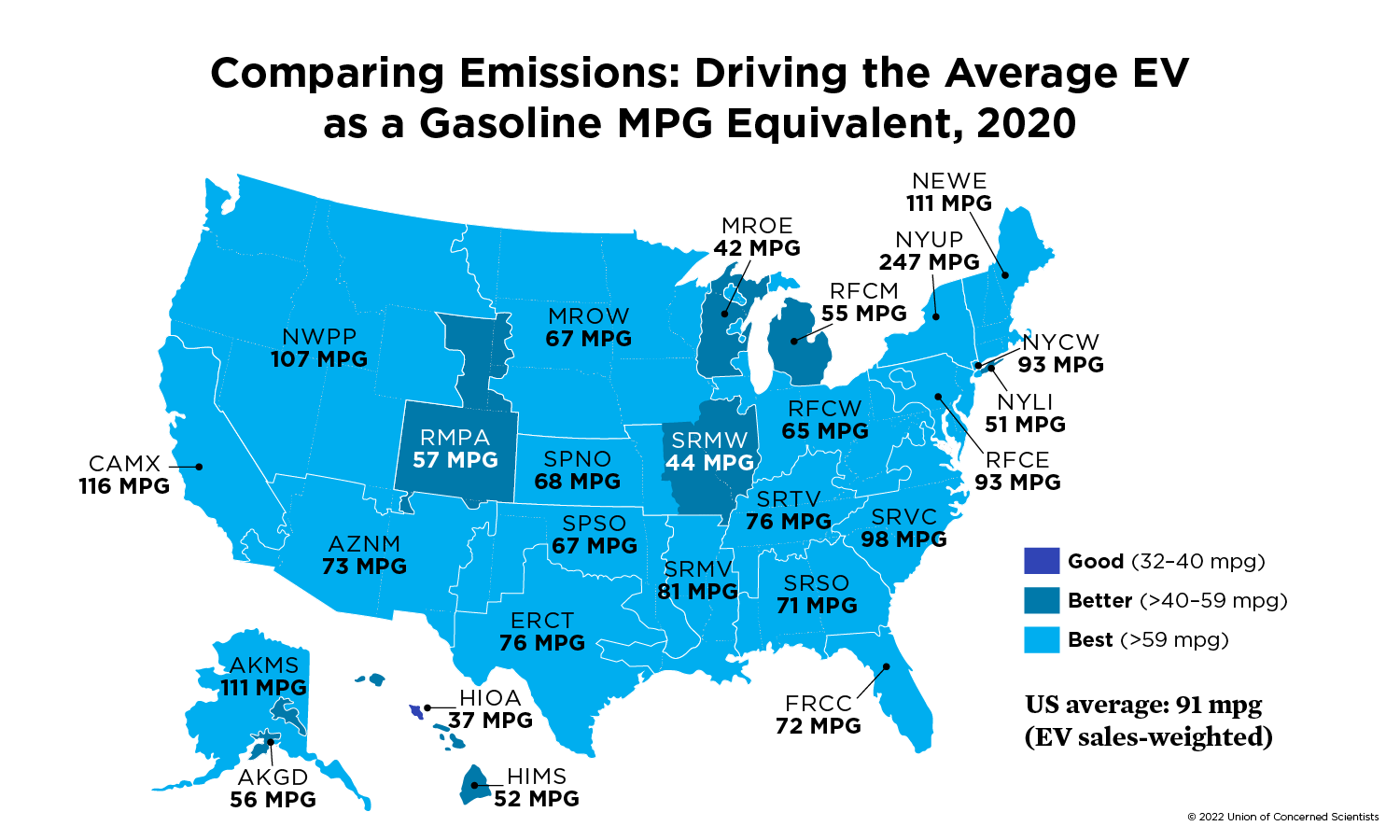
For our entire trip, we were charging our Model Y off a grid that has a better emissions profile than we could have matched by driving our Prius that gets 50 mpg on a good day. And this is significantly lower than traditional internal combustion engine cars that still make up over ¾ of the new cars purchased in the United States.
The second advantage to buying and driving an EV is that the emissions profile for an EV can significantly improve as our nation transitions to a higher proportion of solar and wind power and as we start constructing more new nuclear power plants again. The emission profile for internal combustion engines will remain the same; the amount of carbon dioxide released when you burn a gallon of gas will not decrease.
I am not attempting to fully explore the difference between driving an EV and an internal combustion engine in this blog post, only to share how Celeste and I have found driving an EV across our great country as enjoyable and easy.
Have you taken a long road trip with an EV? What has your experience been? What did you do with the time off the freeway while you charged your vehicle?
Jim
Thanks for sharing your experience! I write about my EV road trips as well. Charging stops are 100% necessary and even a few times I've had to add an extra non-charging stop because I have kids who need the restroom. A lot of our charging stops end up being at truck stops along the highway, which allows us to be just as efficient with our time as we were with our Subaru Forester before. Most of the time we bring a cooler with "real" food and save on both money and calories. The one thing I always look for now are picnic tables. Last week we set up beach towels and a beach umbrella on the grass at a charging stop coming home from Myrtle Beach, and ate our lunch while the car charged.
Familiar story to me, I have been a beta tester for Tesla on my 21MYLR. I have never enjoyed long road trips (58 years driving) as much, especially since the self driving softwarte has FINALLY become capable, I know it is a better driver than me. My 550 mi run to Ohio gets pretty wearying, especially coming home and needing to navigate the storm ravaged gap on I 40, a winding single lane in construction, accompanied by strings of tired semi drivers. Now that treacherous road is a breeze, I can't help remembering how tough it was on manual, and smiling.
Similar story in my several times per year trek to the Florida Keys, 1350 miles towing a 9000 pound boat + trailer. The Chevrolet SilvErado RST has Super Cruise, a mellow highway autopilot system that combines adaptive lane changing cruise control for highway driving. I still stop halfway to rest but now I arrive with decent personal energy. The normal 500+ mile range for this vehicle is still decent at 250 when loaded to capacity.
Final thought, I almost want to thank our political "leadership" for arranging the current lavish prices for transportation fuel, I still use my old Prius for grocery shopping at our neighborhood .
high slope parking lot. The cost of energy for that machine is much higher than the Tesla and still a bit higher than for the truck, which weighs 9500 punds empty.
EVs are here to stay, and you'll have to search high and low to find an EV owner that wants to go back to ICE.