

Posts on co2mmit are published at 8:02 AM Eastern Time. I chose 8:02 AM to honor the birthday of John Tyndall (August 2, 1820 - December 4, 1893). Now, on August 2, I want to remember his contributions and his life on his birthday.
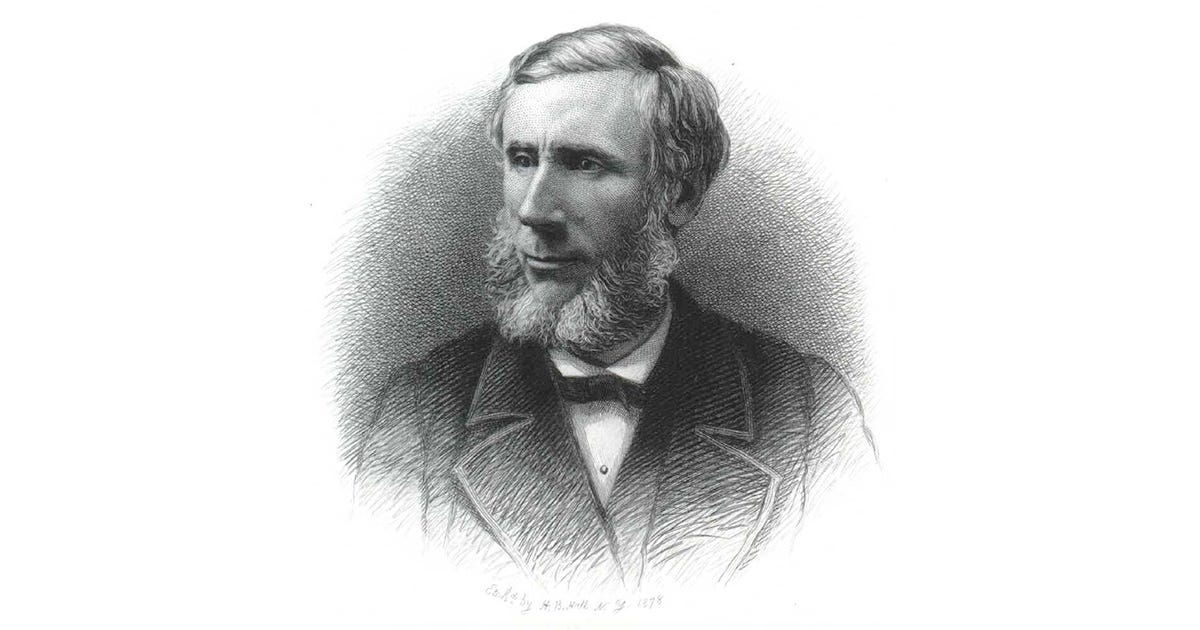
When I was in school studying geology and chemistry, I enjoyed learning the sciences, but I was not interested in the personal histories of early scientists that were inserted in the text books: scientists like John Tyndall. As I have aged, I’ve gained a significant appreciation for the work and tenacity of these pioneering scientists. Scientists in the 1700s and 1800s were clever, original and inventive as they created new methods and frameworks to view our world in order to test out their ideas about how the world works. And these scientists were also human with their own flaws and limitations.
In the late 1850s John Tyndall worked to understand the movement of ice in glaciers using both field scale observations in the Alps and lab-based observations at his laboratory in London. Tyndall challenged his contemporary James David Forbes (1809–1868) who held alternative ideas on the flow of ice (a solid) in a glacier as if the solid were a viscous liquid.
Just one generation after William Smith (1769-1839) published the first country-wide geologic map of England, scientists (natural philosophers) were speculating on the why fossils of organisms that grow in warmer environments were observed further north than they could live with the current climate. The scientists were trying to understand our world before the ideas of plate tectonics were put forward, examined and accepted. A major concept held by many scientists at the time was that the earth was constantly cooling, providing one possible explanation for warmer seas being present long ago to deposit the fossils observed in England and across much of Europe.
But observations about ice deposits (glacial drift) across England indicated that the more recent past had a series of ice ages, challenging this “constantly cooling earth” theory. At some point northern Europe had been much cooler than it was in their day.
Some began to focus on variations in solar radiation as a possible explanation, long before the Serbian geophysicist and astronomer Milutin Milanković published in 1912 on what we now call Milankovich cycles. But in the 1800s there were significant advances in our understanding of the role of our atmosphere’s impact on the temperature at the surface of the Earth.
Eunice Foote’s 1856 paper provided the first documentation that carbon dioxide and water vapor in air absorbs heat - a driving principle that is required to understand how and why our current climate is changing.
John Tyndall created his own apparatus to quantitatively measure how much heat different gases absorb, and published measurements of how much heat is absorbed by carbon dioxide and water vapor in air samples.
Forty years later, Svante Arrhenius (1859-1927) used their work to estimate how changes in carbon dioxide in the atmosphere (called carbonic acid at the time) would change temperatures we experience at the surface of the Earth. In 1896 he published his calculations in a paper titled “On the Influence of Carbonic Acid in the Air upon the Temperature of the Ground.”
The individual lives and work that helped us understand our world is almost as fascinating as the geology, geochemistry and atmospheric science itself.
If you would like to understand more about the people and the history, here are some books that do not require a science background that you might enjoy on your reading list:
Alice Bell. Our Biggest Experiment: An Epic History of the Climate Crisis (for a read on climate science history)
Sarah Dry. Waters of the World (for a read on the scientists who expanded our understanding of our oceans, atmosphere, and ice sheets)
Steven Johnson. The Invention of Air; A Story Of Science, Faith, Revolution, And The Birth Of America (for a biography of Joseph Priestly related to the chemistry of gases - our initial understanding of what “air” is)
I’d like your recommendations, too. Please share recommendations for enjoyable reads on the history of scientists that expanded our understanding of the world we share.
And, on August 2, take a moment to remember John Tyndall.
“Knowledge once gained casts a light beyond its own immediate boundaries.”
John Tyndall
Jim
Post Script: for my readers in Mountain Time, my posts are published at 6:02 AM Mountain Time and you can link this to the June 2 birthday of Clair Cameron Patterson (1922–1995): a geochemist at California Institute of Technology who in 1953 used lead isotopes to estimate the age of the Earth to be 4.5 billion years old and who also contributed to our understanding of environmental lead exposure from his work in the 1960s and 1970s.
Thanks for this terrific retrospective as well as previous insights, Jim Jim. I’m continually amazed at how long ens has been there that CO2 is warming the climate.
I was interested in the book “our biggest experiment: “ I think you have a typo. The author is Alice Bell, e not a. Thanks.