

The numbers can feel overwhelming. Emissions caused by households are a major part of the climate challenge, yet they sound so small when compared to total global emissions. An average US household has a carbon footprint of 48 tons of CO₂e per year (CO₂e is carbon dioxide equivalent). When you multiply that by the 133 million households across the country, you arrive at a total of 6,384 million tons of CO₂e annually. Lowering household contributions is necessary to meaningfully lower US greenhouse gas emissions. And there is nothing stopping us from taking different actions today. We do not need to wait decades for comprehensive policy changes. We can’t wait decades - the clock is ticking. Its time for us to have our own, personal plan to reduce our greenhouse gas emissions.
Household consumption directly and indirectly accounts for 70% of global emissions. Our daily decisions—what we buy, how we travel, what we eat, and how we heat and cool our homes—are levers with direct power to create change.
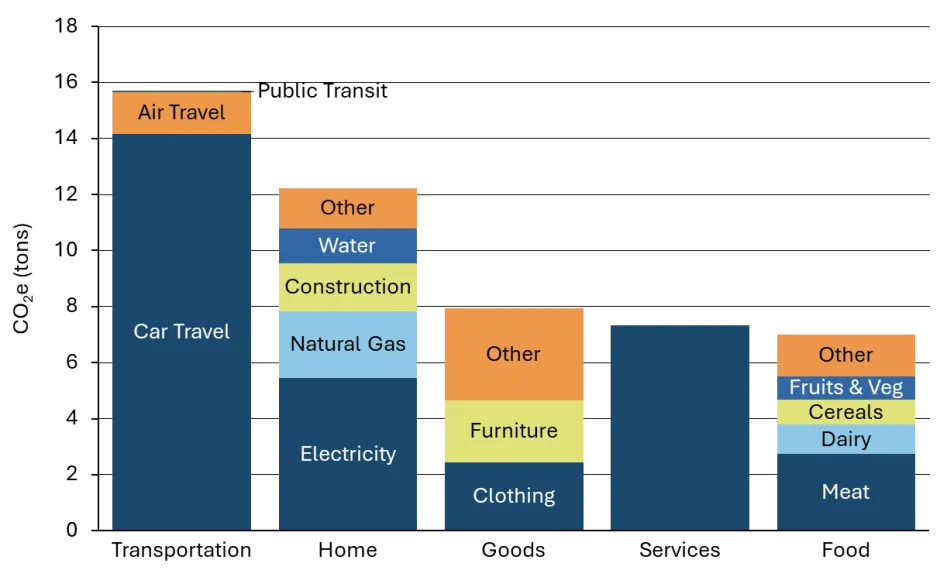
To better understand these emissions, the University of Michigan breaks down the carbon footprint of a typical US household into five primary categories:
Transportation: Emissions from our vehicles and other travel.
Home: Emissions from heating, cooling, and electricity use.
Goods: Emissions associated with the production and disposal of physical items we purchase.
Services: Emissions caused by services we use — from healthcare to finance to education.
Food: Emissions from our diet — from farm to table.
I recommend estimating your own carbon footprint at a household level. A good tool for your use is the University of California, Berkeley Cool Climate calculator. For air travel, a specialized tool from MyClimate is appropriate. I will be presenting a custom application to estimate the emissions from your diet when we discuss food choices in the next post.
My Household Emissions
Over the last eight years, my wife Celeste and I have worked to cut our own emissions. For the sake of simplicity and method limitations, I do not include the goods and services we use beyond our diet, our car manufacture (life cycle), and our home construction. I have calculated our emissions as accurately as I can for six of those eight years. The overall picture shows a reduction from 2018 on the right to 2025 on the left.
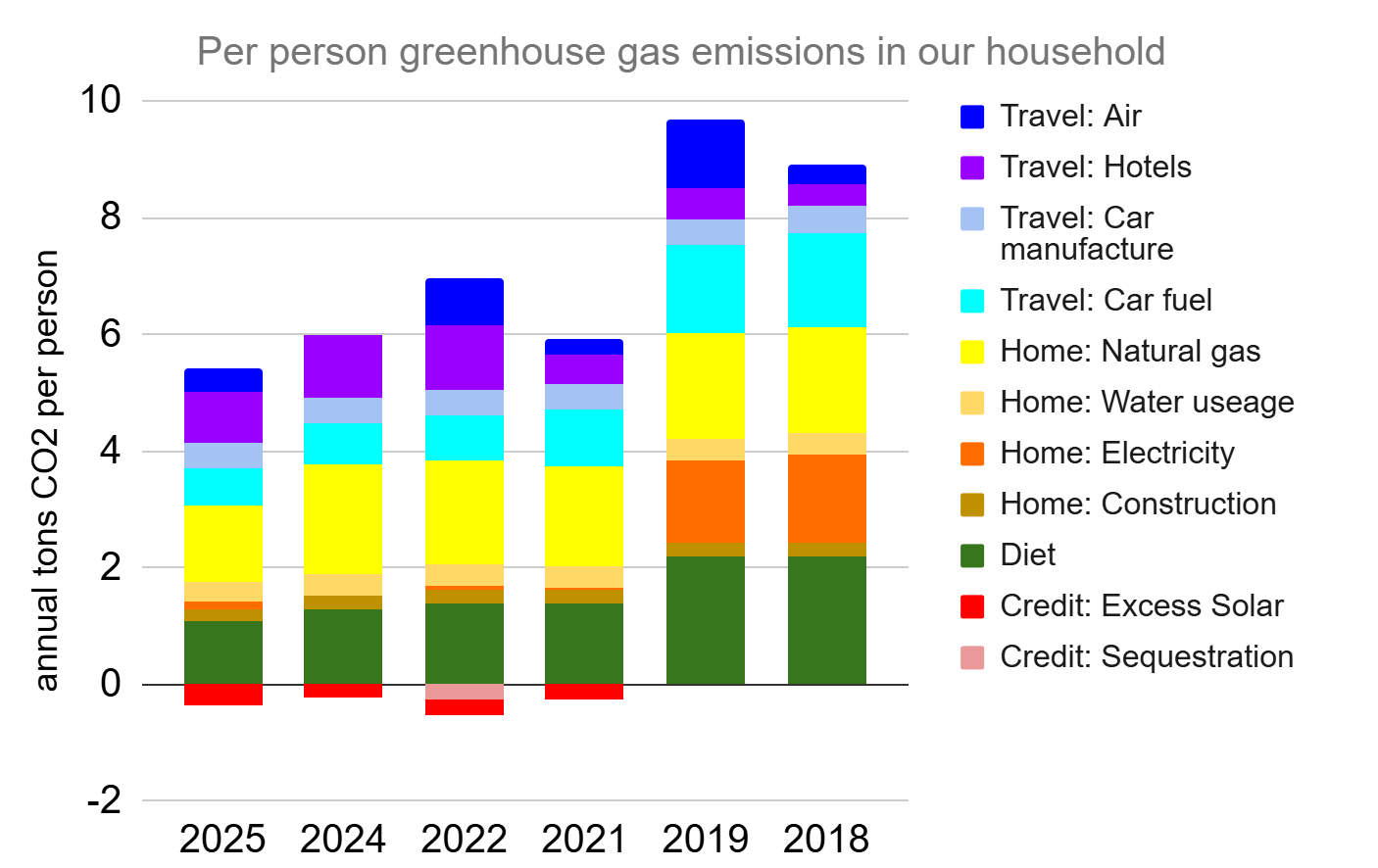
Our journey demonstrates that personal actions can cause real, measurable reductions. Here are some of the specific actions we’ve taken:
Solar Panel Installation (2020): This required a significant upfront capital investment and drastically reduced the emissions from our electricity use. The panels generate clean power, and the monthly savings provided a payback period of about 11 years, making it a financial win also.
Dietary Shift (2020 & 2025): We shifted to a mostly vegetarian diet in 2020 and eliminated most of the remaining meat and dairy in 2025— and we no longer consume any beef. This change requires a commitment but is less expensive than our previous eating habits, providing a substantial cut in our food-related carbon footprint with a modest reduction in cost.
Electric Vehicle (EV) Purchase (2020): Buying an EV meant a cleaner choice for our transportation. We now use it as our primary car and for longer road trips, significantly reducing the gasoline we burn.
Home Envelope Improvements (2024-2025): We improved the insulation in our home’s knee walls and crawl space. Addressing air leaks and poorly insulated areas is a foundational, yet often overlooked, step that immediately makes our home more energy efficient and cheaper to heat and cool — reducing our emission.
Heat Pump HVAC System (fall 2025): We installed a dual fuel heat-pump with natural gas as backup for the coldest days. Before this we relied on a furnace burning natural gas with two resistance space heaters for two rooms that had poor insulation. With the insulation upgrades, we also eliminated using the two resistance space heaters for the colder rooms since resistance heating is extremely inefficient. Installing a heat pump HVAC system required more capital than simply replacing our old HVAC system in-kind, and I do not anticipate that the reduction in our natural gas bill will pay off the additional cost.
Each of these steps required planning, a commitment to make a different choice, and for one change a financial commitment to act according to our values even when it cost more. There is no single, one-size-fits-all recommendation here. Some changes save money, some changes cost more. Each change depends on your current living situation and practices. Every decision is personal, requiring personal change and resources.
In the following weeks, I’ll initially focus in on four areas where are actions are clearly in our control and significantly impact our emissions:
Diet
Car travel
Air travel
Home Energy Use
Let’s discuss in the comments.
Have you calculated your household or personal greenhouse gas emissions? If you have, what was your greatest insight from the results?
What actions have you taken to reduce your greenhouse gas emissions? Did they cost more or less? What were your largest challenges to taking the action?
I hope you’ll continue with this dialogue as we dig into our own personal choices and the emissions we cause—and which actions can meaningfully reduce our emissions.
Jim
“Efforts by households to reduce pollution and waste, and to consume with prudence, are creating a new culture. The mere fact that personal, family and community habits are changing is contributing to greater concern about the unfulfilled responsibilities of the political sectors and indignation at the lack of interest shown by the powerful. Let us realize, then, that even though this does not immediately produce a notable effect from the quantitative standpoint, we are helping to bring about large processes of transformation rising from deep within society.”
Pope Francis. 2023. Apostolic Exhortation Laudate Deum.
My wife and I are committed to helping, but measuring is difficult now that we moved from a home with solar panels to a retirement community (that works on sustainability itself).
We are vegan/vegetarians. We gave up flying about eight years ago (June 2018).
We have heavily donated to The Nature Conservancy's NC Peatland Restoration work as a form of truly offsetting our lifetime carbon footprint. Commercial carbon offsets have a serious credibility problem, but the work TNC is doing is believable. We attended a lecture by the lead researcher in the field, read research papers, and visited the sites. TNC is not trying to sell their work as offsets per se, so we use the figures they calculated to estimate how much our donations have contributed to carbon reduction. We believe that we are making significant progress on offsetting our past emissions.
Thanks for the great writing and highlighting these important climate-friendly lifestyle decisions we all can make Jim!