

How we heat our homes is a significant wedge in our greenhouse gas emissions. Installing a heat pump is a meaningful step to reduce greenhouse gas emissions while also reducing monthly energy bills.
In this post I share my experience converting two natural gas furnaces into two dual-fuel heat pumps. Let’s walk through the path I took and then explore the changes in energy used based on energy bills from the first winter season after the installation.
If you want to read more on heat pumps, I recommend reviewing the content that Rewiring America has posted. I will not try to re-create these educational resources here when Rewiring America provides a solid, current overview.
My journey to install heat pumps
There are only a few ways to cut a ton of CO2e emissions per year from my household’s emissions. Optimizing how I heat my home is one of those target actions. For me, it was one that took a few years to plan, gain comfortable with the swap, and finally make the change, especially as this change involved a capital investment in my home.
Celeste and I took a number of other actions first: actions that either had quicker pay back periods or did not even require any additional capital investment. Early in our commitment to lower our emission, Celeste and I installed solar panels on our roof. We oversized the system to account for additional loads as we planned to electrify other energy uses. A year later we bought an EV which uses some of the surplus from the solar panels. But we still had two natural gas furnaces we used for heat: one in the crawl space for the first floor and one in the attic for the second floor.
We talked to contractors and received quotes for heat pumps about five years ago. Living in Asheville, where winter with temperatures are often over 30° F, and also where we have cold spells with low temperature below 10° F, we explored dual fuel heat pump options. In a dual fuel system, we retain our existing natural gas furnace and replace our air conditioner unit with a high efficiency variable speed heat pump. If temperatures outside are above a specific temperature we can adjust, the heat pumps warm the house; and when temperatures drop below the set temperature, the system switches and uses the natural gas furnaces to heat the house. The first time we got quotes, we did not authorize the work. The capital required simply was larger than we anticipated.
In 2024 we decided to make the transition to dual fuel heat pumps.
Our first step was to improve the heat envelope on our home so we were not simply improving how we heat a leaky bucket. The main areas needing improved insulation were in the knee walls, as well as some work in the attic and improving the insulation on the access points for the attic and the knee walls. This insulation work was completed in December of 2024. We also lined our crawl space in February 2025 for moisture and air quality issues as well as improved insulation of the space under our floors.
Next we updated our bid list of contractors with recommendations and refreshed our quotes for installing two dual-fuel heat pumps.
The bid site walks were informative. I am not an HVAC specialist, and I appreciated walking with the representatives of the firms that bid and asking questions and listening to their suggestions and advice. One local contractor tried to talk me out of installing heat pumps and indicated that he had never provided a quote for a dual-fuel heat pump. If someone does not support the product they are bidding for me, it is a major red flag that they may not understand or have experience with the products I want installed. I had a significantly different conversation with the two contractors that I knew were experienced installing heat pumps. They talked about the benefits of both options of high efficiency heat pumps without the alternate fuel option and dual fuel heat pumps retaining my existing natural gas furnace for the coldest nights.
We ended up choosing a family-owned contractor that has serviced my area for four generations: Bolton Services. Our two heat pump units were installed in August of 2025, before the 2025-26 heating season. Now that it’s spring of 2026, I can run the numbers to evaluate our natural gas and electricity use during the winter season of 2025-26 and see how they compare to earlier seasons.
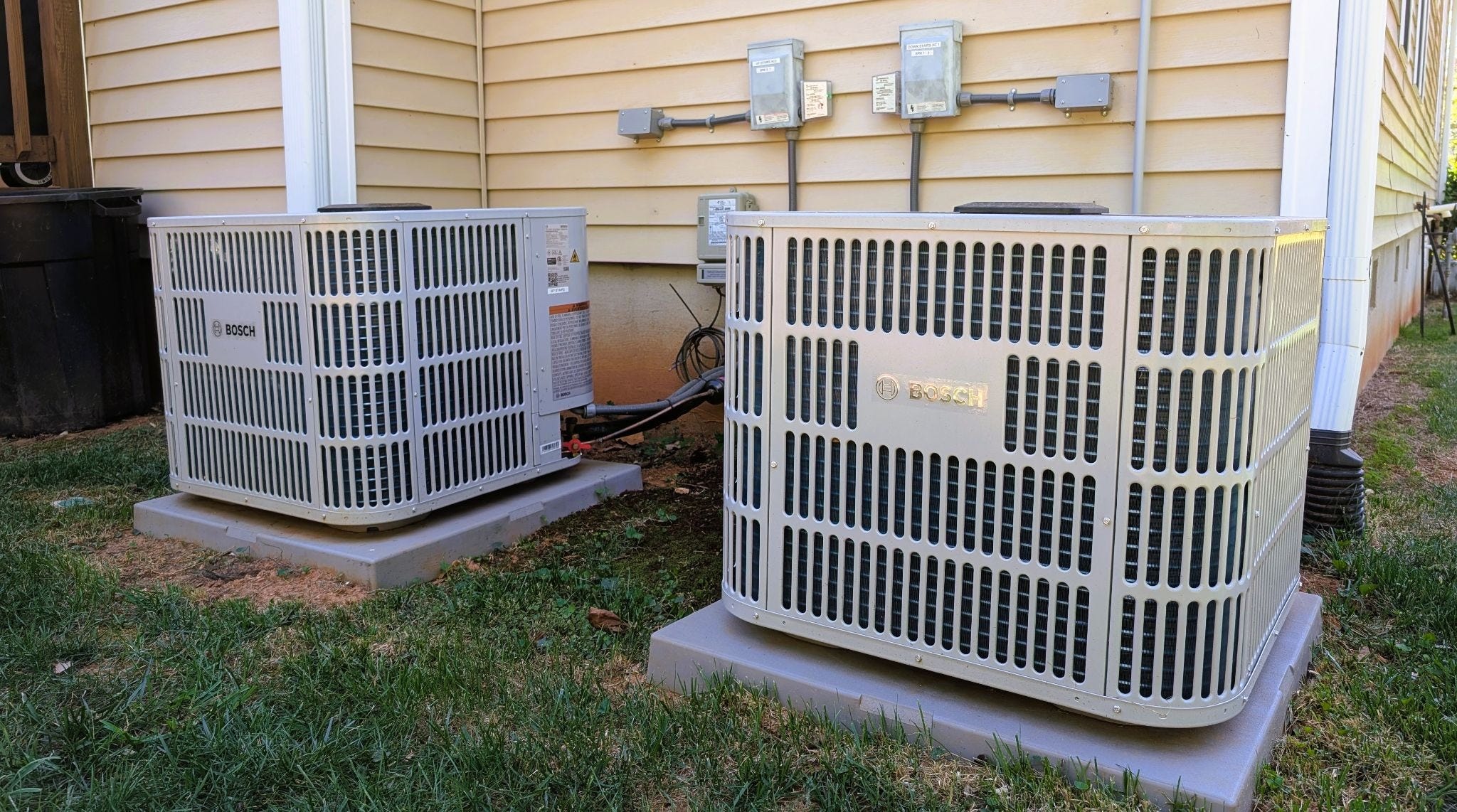
During the winter of 2025-26, we had our dual-fuel systems switch to natural gas when it was 35° F outside. Our indoor temperatures were comfortable and next year we will try more of the year with the transition at 30° F or 25° F.
Our arrangement with our utility (Duke Energy Progress) provides us with meter readings for the electricity we produce with our solar panels and separately all of the electricity that we use from the grid. The electricity from our solar panels is simply put back on the grid, and the energy used minus energy generated is what we are billed for. In most months, we have an excess that carries forward as a growing credit until it is zeroed out each June.
After a full heating season with the new system, it’s time to see if the investment paid off—both environmentally and financially
Change in Energy Used
To evaluate the impacts of our dual fuel heat pump systems along with the improved insulation (mentioned earlier), I run the numbers as if I do not have solar panels, which may be more relevant for many home owners. It is then a simple shift to explain the impact with the solar generation.
I tracked the kWh of electricity and the therms of natural gas I used each month from September through April for three seasons before installing the heat pumps (2022-23, 2023-24 and 2024-25) and took an average of these three winter seasons as a baseline for how much energy I used during a season heating with natural gas. I tracked my total energy use for the most recent winter season with the heat pumps installed (2025-26).
During the baseline winter seasons, when our heat was coming from natural gas furnaces, we used a Vornado space heater to keep one particular room we occupied a bit warmer. We had excess electric credits from our solar system, so the heat from the Vornado resistance space heater was “free” for cost, and zeroed out on our annual emission inventory. That said, resistance heat is one of the least efficient ways to heat a room - causing more emissions than burning natural gas. To eliminate the large draw from the resistance heater, this winter season we also stopped using the Vornado space heater. This past winter season we simply turned the thermostat up a degree or two and kept the first floor warm enough to assure that the room of concern was comfortable.
Overall, we used more electricity and less natural gas during the most recent winter.
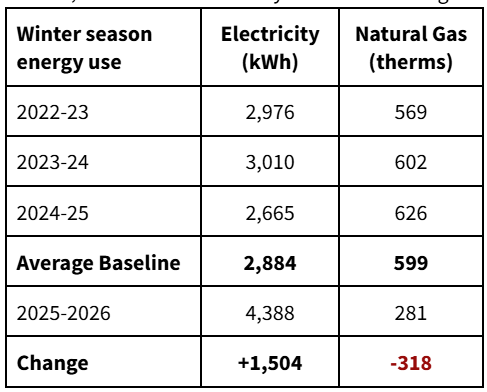
Heating with dual fuel heat pumps last winter, we used 1,504 kWh more electricity and 318 therms less natural gas. In these units, it is hard to compare the increased electric use and the decreased natural gas use. So I’ll convert them to the same units: first to dollars (USD) and second to tons of CO2e emissions.
Change in my bills
The marginal cost on my utility bills of an additional kWh of electricity is 12.32¢ and an additional therm of natural gas is $1.64. These values include the North Carolina 6% sales tax. Using these conversion rates, the following change occurred for the winter of 2025-26:
+$185 electricity bill charges
-$522 natural gas bill charges
-$337 total bill change over the winter season
So, over the seven month winter season in 2025-26 I saved $337 on the combination of my electric and natural gas bills.
Emissions shift
To convert the changes in electricity use to tons of CO2e emissions, I used the conversion factors for North Carolina’s electric grid from the Energy Information Agency. The conversion is 670 lbs CO2e/MWh which is equivalent to 0.0003039 tons/kWh.
To convert the changes in natural gas use to tons of CO2e emissions, I used the conversion factor from the USEPA. The conversion is 0.0053 tons CO2e/therm. It is important to point out that this is a simple conversion based on changing all of the carbon in the natural gas (CH4) into carbon dioxide (CO2). This number is NOT a life-cycle analysis of all of the releases and energy used to provide that extra therm of natural gas. Adding in the whole life cycle for releases of methane at leaks and the energy used to generate the natural gas would add 20% to 40% to the emissions for natural gas.
Using these conversions, the following change in emissions occurred for the winter of 2025-26:
+0.46 tons CO2e from electricity
-1.69 tons CO2e from natural gas use
-1.23 tons CO2e change over the winter season
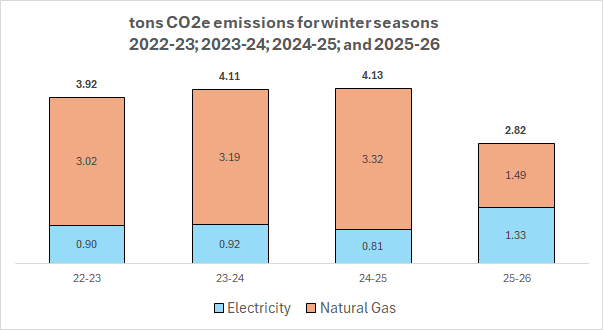
Over the seven month winter season in 2025-26 my greenhouse gas emissions were 1.23 tons CO2e less than during a typical winter season heating with natural gas. Here is a graphic showing the emissions during the three baseline winter seasons and last year (2025-26) when the dual fuel heat pumps were used.
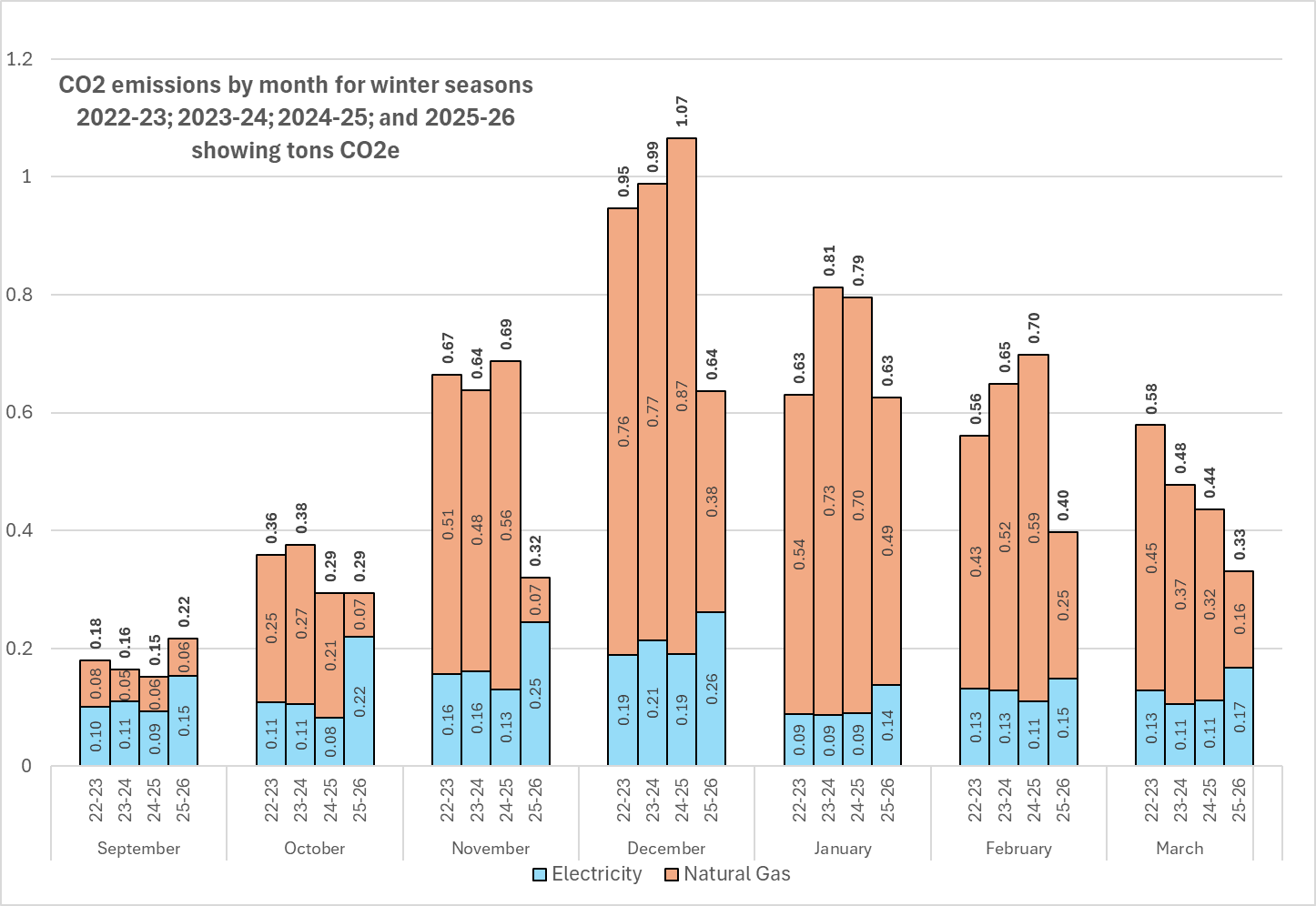
Below is a graph of the CO2e emissions for my total energy use by month providing a more detailed view.
I calculated the change in cost and emissions as an illustration for houses that do not have solar panels. However, since my home has solar panels which are oversized, my emissions changes were a decrease of the full 1.69 tons CO2e from the natural gas. If you add on 30% to better approximate the life-cycle emissions from that natural gas which includes production and transportation, the emissions reduction was over 2 tons CO2e.
Also, since I generated the additional electricity, the savings last year was also estimated at $522, not just $337.
Also, the three baseline winter seasons (2022-23, 2023-24 and 2024-25) were all a bit warmer than average. In contrast, last winter (2025-26) was cooler than normal. So this comparison underestimates the actual amount of emissions reductions and cost savings.
It is difficult to find many actions that can reduce over a ton of emissions from our carbon footprint. Celeste & I remain pleased with the performance of Bolton Servicers installing our heat pumps, pleased with the comfort in our home, and thrilled with the reduction in our greenhouse gas emissions.
As mentioned earlier, changing to heat pumps was not our first action to bring down our emissions. Before taking this step, we added solar panels, bought an EV, changed our diet to mostly vegan, and insulated our home. All of these previous steps either saved us money or had a reasonable pay-back period. The two heat pumps cost around $8,000 to $10,000 more than simply replacing our older AC units with new, traditional AC units and continuing on with natural gas heating. Saving $522 per year just gets us to covering the replacement cost of these units over a 15 to 20 year expected life cycle. But not by a lot and not with a cost of money factored in.
But installing the heat pumps was not about saving money. It was about continuing a commitment to lower our emissions. Heat pumps are available today. They heat homes adequately to maintain comfort. There was nothing stopping us from doing this earlier other than budget concerns and stacking changes in a sequence to work through.
For Celeste and I, cost is a real factor but it is not the anchoring criteria for right actions or for following our faith and convictions.
I encourage you to talk with local contractors well before you need a new furnace or air conditioning unit, explore your budget options, and plan for a future with lower emissions. And find local contractors that are known for installing heat pumps. If you go to a contractor that does not install heat pumps, they will sell you what they know - a natural gas furnace.
I hope this overview of the actual impact of heat pumps on our household energy use and energy bills can help in your planning.
Jim
Too bad you did not investigate inverter style heat pumps as they are noticeably more efficient. We live some 100 miles north of you in NE Tennessee and heat with a HP only. As long as the temps are at least in the teens the HP wins. Single digits the supplemental heat may kick in. Fortunately that is rare in our area. And not having the extra fixed cost of gas pays for those few cold mornings.
I live in Seattle and have a similar range of winter temperatures as you. Mostly over 30, often 35-45 but sometimes down to the teens and twenties. My contractor recommended a dual fuel system a few years ago and I wondered if we couldn't have gone fully electric with a properly sized heat pump. I wonder what your thoughts are on that and why you chose dual fuel over full electric.