

I am convinced that for the United States to reduce our greenhouse gas emissions, people – you and I – must reduce our own emissions. Reducing emissions will take good policy, but reducing emissions will also take personal change at a household and individual level.
My path to reduce my own carbon footprint spans years – across my education, my career, and my post-career. After getting a Masters of Science in environmental geochemistry, I spent 29 years investigating and cleaning up contamination from past industrial operations. In almost all of these cleanup projects, the corporations I counseled had stopped discharging waste to the environment years earlier and my involvement was determining where the contaminants had gotten to and how to clean them up. These contaminants included previously common industrial cleaners like trichloroethene (TCE), chlorinated industrial products and pesticide intermediaries, chlorinated dioxins and furans as well as petroleum products and metals. We now understand that these chemicals are toxic to humans and negatively impact wildlife. And we started managing these chemicals more carefully decades ago after new laws were signed into law.
Climate change is fundamentally a different problem.
Both the industrial cleanup operations and climate change are caused by the discharge of waste into the environment. The two main waste products that cause climate change are emissions into the atmosphere of
carbon dioxide (CO2) from burning fossil fuels like gasoline, jet fuel, natural gas and coal and
methane (CH4) from natural gas leaks, landfill vents, and cow burps.
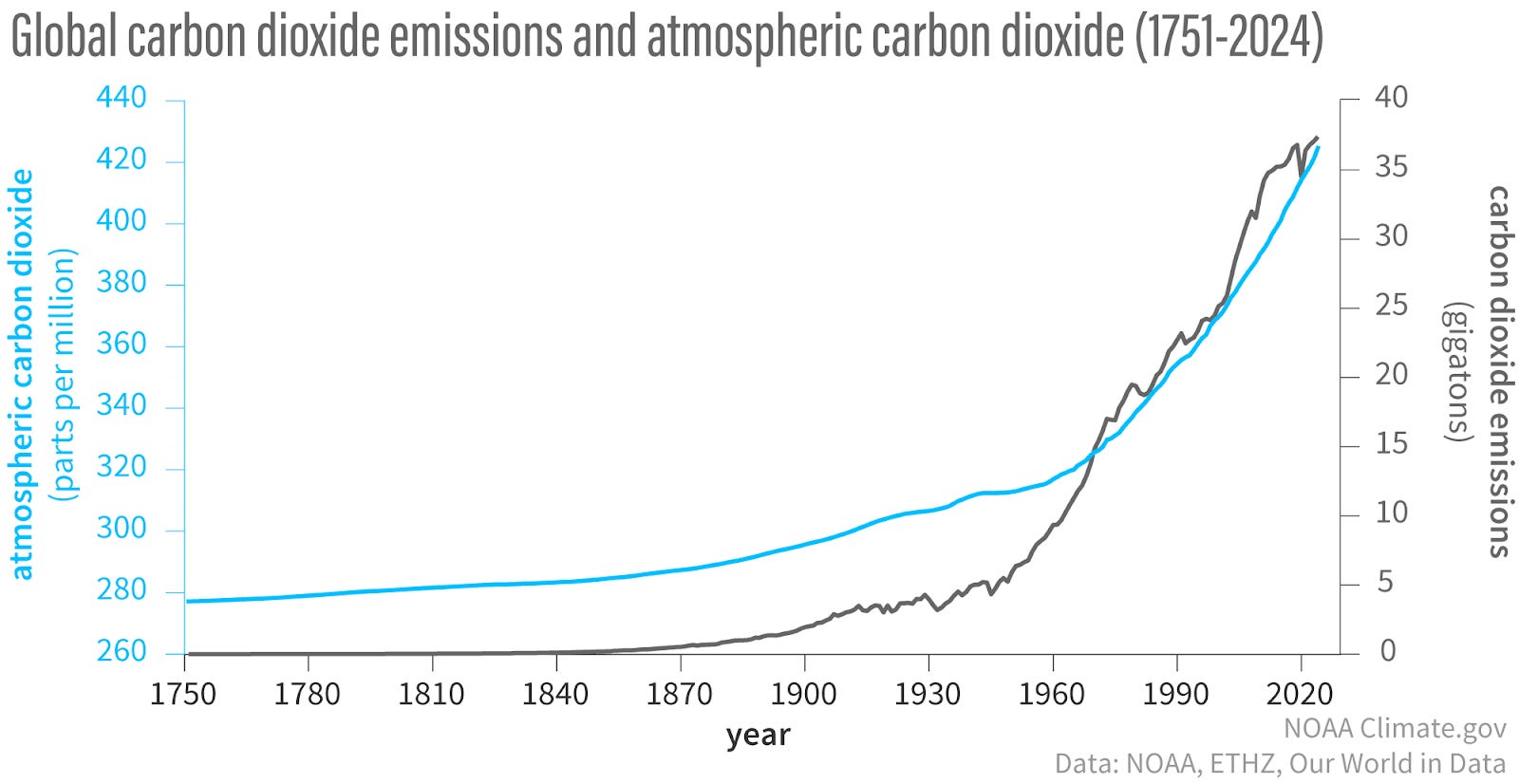
Yet even now, decades after understanding the risk from climate change, the United States continues to discharge both carbon dioxide and methane at even greater rates. We did not stop the discharge, we increased it. And, unlike the industrial spills I worked on, emissions of carbon dioxide and methane are clearly linked to our household purchase decisions – my decisions and your decisions.
So thirteen years ago, after cleaning up contaminated groundwater, soils and sediments for three decades, I changed my focus to attempt to have an impact on our greenhouse gas emissions. I have not been very successful. Total US emissions have not decreased, and global emissions continue to rise. When I started, I did not understand the critical importance of my own actions - to reduce emissions, send a market signal and set social norms for acceptable behavior. I will continue to advocate for improved laws and regulations that nudge or require businesses to lower the emissions from their operations and require different actions by you and me. But I have realized that climate change is also a problem of individual will – a problem caused by the decisions that you and I make. A critical step is to understand that each of us can change our behavior now, without any new law. And it is hard to pass laws to demand behaviors we are not willing to change on our own.
Household purchase decisions provide the market demand for 70% of greenhouse gas emissions. Changing our purchase decisions can change our emissions. Our choices matter, and our current collective choices are not aligned with the reality of the issue we face in climate change.
Subscribe to this blog (at no cost) to join a dialogue exploring how our actions can reduce greenhouse gas emissions.
Personal action will not replace the need for good laws and regulations. But one lesson I’ve learned is that getting laws passed through Congress can take lifetimes - time we do not have to reduce emissions. After a decade exploring better laws and regulations, and seeing some laws passed and then weakened, I am convinced that those of us who are concerned about climate change need to both continue pushing for good laws while simultaneously controlling the one area fully in our control - our own actions.
According to Yale and George Mason University, over half of the U.S. population is alarmed or concerned about climate change, yet our collective actions don’t reflect this understanding. Assuming that our individual choices don’t matter, or that governments and corporations must act first ignores our own agency and the power of individual actions.
Switching to a diet that eliminates beef and reduces other meats can cut over 1 ton of CO₂e per year from an individual’s emissions—a massive, meaningful reduction. Yet while 54% of Americans are alarmed or concerned about climate change, only 5% of Americans identify as vegetarian or vegan. Similarly, personal transportation is a major contributor to our carbon footprints, but the sales of electric vehicles (EVs) have only reached 8% of new car sales with hybrid vehicles representing another 10% to 12%. The gap between our belief about climate change and our actions is significant.
This is an invitation to explore our agency.
This blog will be a dialogue to address the root causes of climate change by exploring one question: How can we meaningfully cut the emissions we cause through our energy use and our purchases? How can we work with the only one area we fully control - our own actions? And why is this so important beyond the emissions I reduce?
What to Expect From This Dialogue
Focus on Impactful Action: The average U.S. household has a carbon footprint of around 48 tons of carbon dioxide equivalents (CO₂e) per year. Future posts will not overwhelm you with a long list of minor adjustments. Instead, they will focus on a handful of high-impact areas where our actions can cut fractions of or whole tons of CO₂e per year —the changes that truly matter and that are required to lower the US per capita emissions.
Real-World Insights: The blog will talk with friends and readers who have already taken these steps. You will learn what they’ve learned, how the transition went for them, and how they overcame obstacles.
A Deep Dive into the ‘Why’: Along the way, I’ll dive into the details—including numbers, graphs, and the occasional bit of chemistry—to understand the science behind our choices. For example, early on we’ll explore why shifting your diet is so impactful, and the importance of the difference between the digestive systems in cows as compared to pigs or chickens.
Behavior Change: Changing our behavior takes effort. Our dialogue will cover what it takes to form new habits and successfully integrate these intentional changes into your daily routines. I will include concrete suggestions to help make these behavior changes stick and feel comfortable.
Secondary Outcomes: Aside from simply reducing my emissions, our individual actions also influence markets for lower emissions options and also shift social norms that are linked to other people’s actions.
It is time to align our actions with our beliefs and reclaim our power to effect change.
Engage in the dialogue in the comments as we explore how to act consistent with our values and our concern about climate change.
Jim Tolbert
Good people will do what they find honorable to do, even if it requires hard work; they’ll do it even if it causes them injury; they’ll do it even if it will bring danger. Again, they won’t do what they find base, even if it brings wealth, pleasure, or power. Nothing will deter them from what is honorable, and nothing will lure them into what is base.
Seneca, Moral Letters. 76.18

Thanks for all the above, Jim. I’m with you on all points. I’m increasingly dismayed regarding the current path our government is taking on this critical issue. But we can’t let that change the trajectory we need to be on. I will be encouraging people in my community to become more aware and involved about what they can do as individuals who want to reduce their carbon footprint. I’m convinced that any meaningful change is only going to happen from the ground up.
Marty
Thanks so much for starting this blog and dialogue. Your message is one of agency and that should give folks hope at this critical time of much needed and real solutions. We can rally and support each other to change social norms when we understand our individual role is vital.